

Contact Info
- Greensboro, NC 27406
- Call: 336-707-0498
- Text: 336-707-0498
-
Mon - Fri: 8am - 4pm
Sat - Sun: Closed
Contact Info
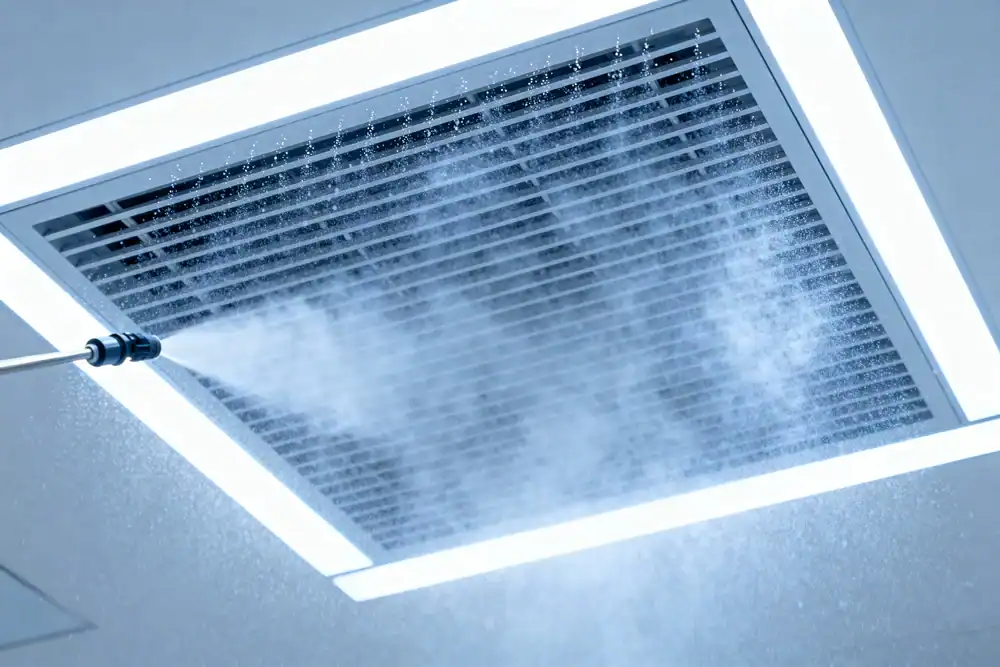
Your employees spend 40+ hours a week breathing whatever’s circulating through your ductwork. When that air is loaded with dust, allergens, and microbial growth, you’re looking at more sick days, slower cognitive function, and a workspace that feels off even if no one can pinpoint why.
Clean ductwork changes that. Studies show that doubling ventilation rates cuts sick leave by 20%. Employees in well-ventilated offices demonstrate twice the cognitive performance compared to those in poorly ventilated spaces. That’s not marginal—that’s measurable.
Chapel Hill’s commercial real estate market is growing fast, with over 500% growth in commercial building permits since 2011. Newer buildings and older ones alike accumulate the same debris over time. Your HVAC system pulls in everything—pollen from the Triangle’s heavy tree cover, construction dust from ongoing development, everyday particulates from high foot traffic.
When ducts get clogged, your system works harder and costs more to run. Airflow drops. Energy bills climb. Equipment wears out faster. Professional duct cleaning removes what’s built up and lets your system operate the way it was designed to.
We’ve spent over 30 years improving indoor air quality for businesses across the Triangle. We’re BBB accredited and we focus exclusively on commercial applications—no residential dryer vents, no side projects that pull attention away from what matters to you.
Chapel Hill’s commercial landscape includes everything from Research Triangle Park’s biotech facilities to UNC-area office buildings and retail spaces in Alamance County. We’ve worked in all of them. We understand the difference between a quick surface clean and the kind of thorough ductwork cleaning that actually makes a difference.
We use industry-leading equipment and follow proven processes. You’re not getting a crew that showed up yesterday with a shop vac. You’re getting technicians who know how to access your entire system, remove contaminants properly, and leave your workplace with measurably better air quality.
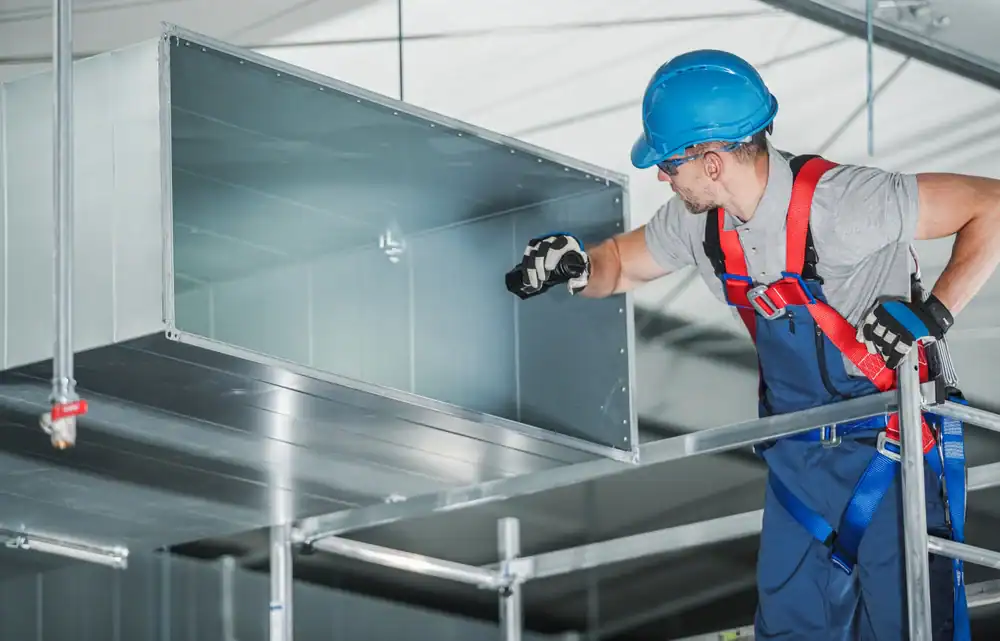
We start with an assessment of your HVAC system. That means identifying access points, understanding your ductwork layout, and spotting any areas where contamination is heaviest. Not every system is the same, and a one-size-fits-all approach misses problems.
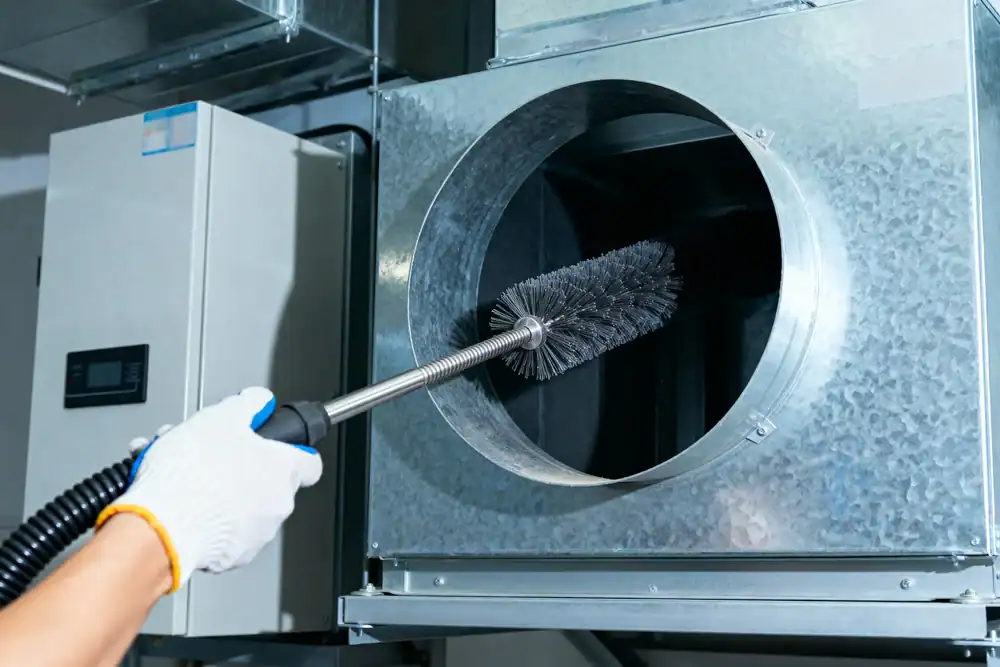
Once we’ve mapped things out, we use specialized equipment to dislodge debris from duct surfaces—brushes, air whips, and compressed air tools designed for commercial systems. This isn’t a vacuum job. We’re physically removing what’s stuck to your ductwork, not just stirring it around.
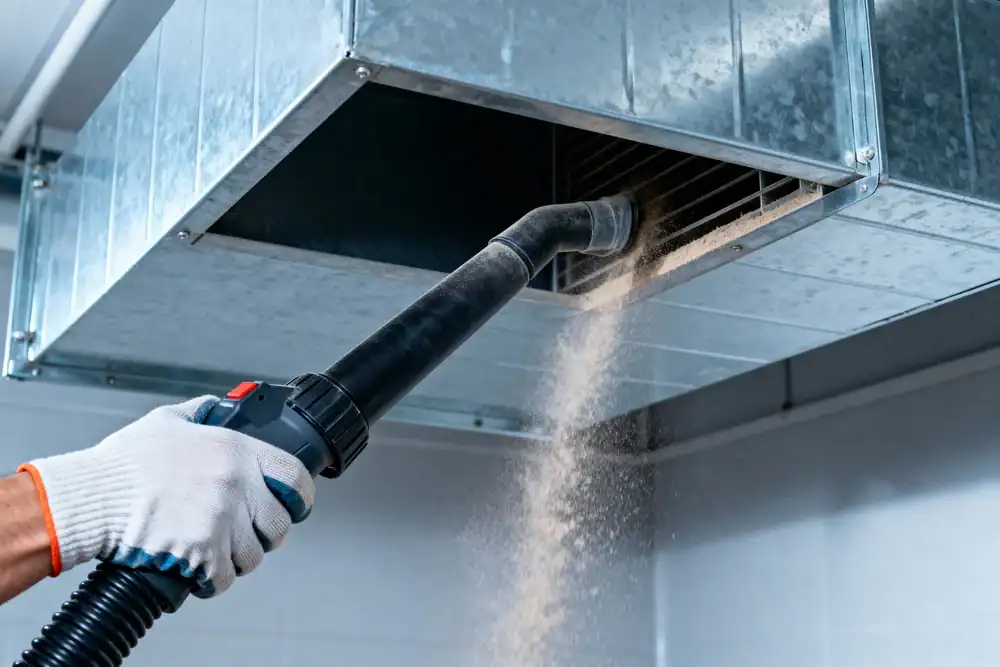
As debris gets loosened, high-powered vacuums with HEPA filtration capture everything. We’re pulling contaminants out of your building, not redistributing them into your workspace. The process is thorough, and it’s contained.
After cleaning, we can apply EPA-approved sanitizers if microbial growth is a concern. We also inspect the system to make sure airflow is restored and nothing was missed. The whole process is designed to minimize disruption—we can work after hours or on weekends if that’s what your schedule requires.
You’ll notice the difference in air quality right away. Your HVAC system will run quieter, more efficiently, and with better airflow throughout your facility.
Ready to get started?
Commercial duct cleaning covers your entire HVAC system—not just the visible vents. We’re talking about supply and return ducts, registers and grilles, diffusers, heating and cooling coils, drip pans, fan motors, and the air handling unit housing.
Chapel Hill’s office buildings average over 75,000 square feet, and many house businesses in industries where air quality directly impacts performance—pharmaceutical companies, tech firms, research facilities near RTP. Those environments can’t afford compromised air systems.
We remove dust, dirt, pollen, mold spores, bacteria, and other particulates that accumulate over time. In the Triangle, that includes seasonal pollen loads that are among the highest in the country, plus construction dust from ongoing commercial development.
The result is a system that operates at maximum efficiency. Harvard research estimates that improving air quality through better ventilation delivers around $6,500 per person per year in productivity benefits. The payback period is roughly two years. That’s not a feel-good stat—that’s a financial argument for keeping your ductwork clean.
You’ll also see lower energy costs. When air moves freely, your HVAC doesn’t have to strain. That means less wear on equipment, fewer breakdowns, and a longer lifespan for a system that represents a significant capital investment.
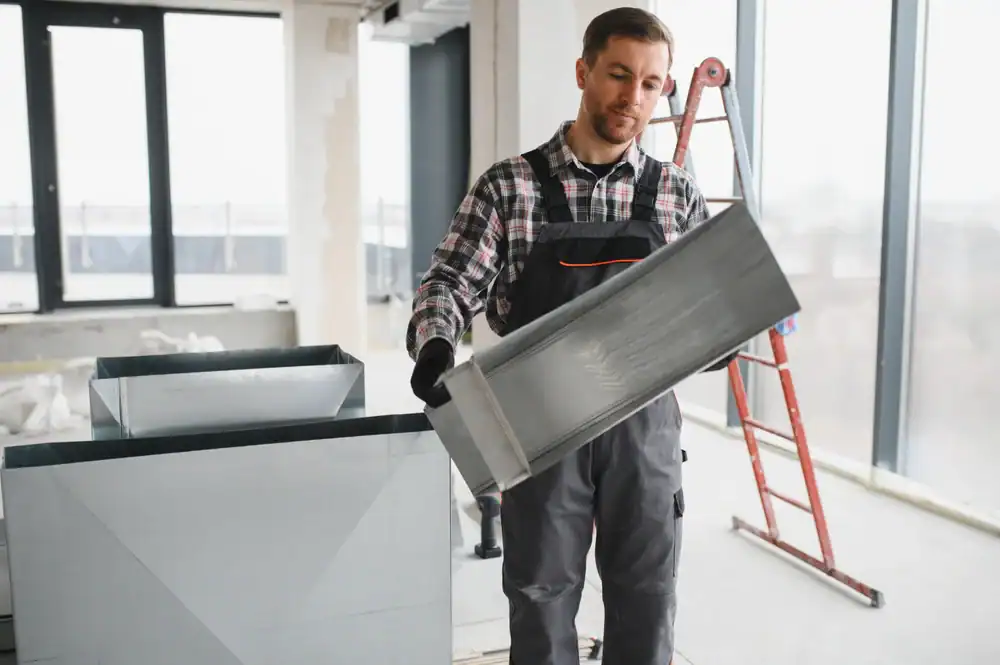
Most commercial facilities benefit from duct cleaning every three to five years, but that timeline shifts based on your specific situation. High-traffic buildings, facilities near construction zones, or spaces with employees who have respiratory sensitivities may need more frequent service.
Chapel Hill’s location means heavy pollen seasons and ongoing development across the Triangle. If your building is near active construction or sits in an area with significant tree cover, your HVAC system is pulling in more particulates than average. You’ll see buildup faster.
Another factor is your industry. Biotech and pharmaceutical companies operating near Research Triangle Park often have stricter air quality standards. Retail spaces with constant foot traffic accumulate dust differently than a low-occupancy office building. If you’ve never had your ducts cleaned, or if it’s been more than five years, you’re overdue. If employees are complaining about stuffiness, allergies, or inconsistent temperatures, that’s a sign your system isn’t moving air the way it should.
Commercial systems are larger, more complex, and require different equipment and expertise. Residential ductwork is typically straightforward—a single-unit system serving a few thousand square feet. Commercial buildings in Chapel Hill average over 75,000 square feet, with multiple zones, larger air handlers, and ductwork that’s harder to access.
The stakes are different too. In a home, poor air quality affects a family. In a commercial building, it affects dozens or hundreds of employees, impacts productivity, and can lead to measurable financial losses. Studies show that poor indoor air quality costs US businesses $93 billion annually in presenteeism alone.
Commercial cleaning also requires minimal disruption. We’re working in occupied buildings where downtime isn’t an option. That means scheduling flexibility, contained work areas, and processes that don’t interfere with daily operations. Residential cleaners aren’t set up for that. We are. We focus exclusively on commercial applications, which means we understand the systems, the standards, and the expectations that come with serving businesses rather than homeowners.
Yes, but the savings depend on how dirty your system is and how hard it’s currently working. When ducts are clogged with debris, airflow drops. Your HVAC has to run longer to reach the same temperature, which means higher energy consumption and higher utility bills.
Clean ductwork restores proper airflow. Your system reaches set temperatures faster and cycles off sooner. That’s less runtime, less energy used, and lower costs. The exact savings vary by building size, system age, and how contaminated your ducts were to begin with, but most commercial clients see noticeable reductions within the first billing cycle.
There’s also the equipment longevity factor. HVAC systems that don’t have to strain last longer and need fewer repairs. When you’re talking about commercial-grade equipment, replacement costs run into the tens of thousands. Keeping your system clean is cheaper than replacing it early. Energy savings are immediate. Equipment savings compound over time. Both matter.
Poor indoor air quality impairs cognitive function in ways most business owners don’t realize. Harvard studies found that employees in well-ventilated offices with good air quality demonstrate double the cognitive performance compared to those in poorly ventilated spaces. That’s not a small difference.
When air is loaded with particulates, CO2 levels rise and oxygen availability drops. Employees take longer to complete tasks, struggle to focus, and have difficulty processing information. Lawrence Berkeley National Laboratory concluded that improving indoor air quality can boost workplace performance by 10%. For a Chapel Hill office with 50 employees, that’s the equivalent of adding five full-time workers without increasing headcount.
There’s also the absenteeism factor. Doubling ventilation rates lowers sick leave by 20%. Fewer employees calling out means more consistent project timelines, less scrambling to cover shifts, and lower costs associated with temporary staffing or overtime. Clean ducts mean cleaner air. Cleaner air means healthier, sharper, more productive employees. It’s a direct line from your HVAC system to your bottom line.
Absolutely. Persistent odors in commercial buildings often trace back to microbial growth, accumulated dust, or debris decomposing inside ductwork. When your HVAC runs, it circulates those smells throughout your facility. Cleaning the ducts removes the source.
Mold and mildew thrive in dark, damp environments—exactly what you find in ductwork with poor drainage or moisture issues. If your building has had water intrusion, roof leaks, or high humidity, there’s a good chance you’ve got microbial growth in your ducts. That’s not just an odor problem—it’s a health problem.
After we clean the system, we can apply EPA-approved antimicrobial treatments to prevent regrowth. We also identify any underlying issues contributing to moisture buildup, so you’re not just masking the problem. Chapel Hill’s humidity, especially in summer, creates ideal conditions for mold. Regular duct cleaning keeps it from becoming a recurring issue. If your building smells off and you can’t pinpoint why, your ductwork is a likely culprit.
Yes. We understand that downtime costs money, and most Chapel Hill businesses can’t afford to shut down for a day while we clean ducts. That’s why we offer flexible scheduling, including after-hours and weekend service.
We’ll coordinate with your facility manager to identify the best time to access your HVAC system with minimal impact on employees or customers. For some clients, that means working overnight. For others, it’s a weekend when the building is empty. We adapt to what works for you.
The process itself is contained. We’re not tearing apart your workspace or leaving dust everywhere. Our equipment is designed for commercial environments where cleanliness and professionalism matter. You’ll see our trucks, our crew will do the work, and when we leave, your building will have cleaner air and a more efficient HVAC system—without the disruption that comes with other types of facility maintenance.