Contact Info
Standing water after a storm means your soil isn’t draining. That water sits against your foundation, building pressure. Over time, it finds cracks, seeps into crawl spaces, and turns a $3,000 drainage fix into an $11,000 foundation repair.
A properly installed French drain system intercepts that water before it becomes a problem. Surface drainage carries runoff away from your home. Subsurface drains handle groundwater that clay soil can’t absorb fast enough.
You stop seeing puddles in your yard after heavy rain. Your mulch stays in place. Your grass doesn’t turn yellow from root rot. More importantly, you’re not lying awake during August thunderstorms wondering if water’s getting into your crawl space.
The Piedmont’s clay soil expands when wet and contracts when dry. That constant movement puts stress on foundations. Good drainage reduces that cycle. Less expansion means less pressure, fewer cracks, and a foundation that stays stable year after year.
We’ve been handling moisture problems in the Greensboro area for years. We started with crawl space encapsulation and HVAC services, which taught us exactly how water moves through properties in this region.
That experience matters when you’re installing French drains in Ogburns Crossroads. We’ve seen what happens when drainage fails. We’ve dried out crawl spaces, removed mold, and fixed air quality issues that all started with poor yard drainage.
Our team understands the local soil conditions. We know how August storms dump inches of rain in an hour. We’ve worked in neighborhoods where homes were built in the early 2000s on clay that needs proper water management. That’s not theory—it’s what we do every week.
We start with a site assessment. Where does water pool? Which direction does your yard slope? Where are your downspouts discharging? Those answers determine where the trench drain goes and how deep we need to dig.
Next, we excavate the trench. In Ogburns Crossroads, that often means cutting through clay and rocky soil. The trench needs proper slope—typically one inch per eight feet—so gravity does the work. We don’t shortcut this. If the slope’s wrong, the system won’t drain.
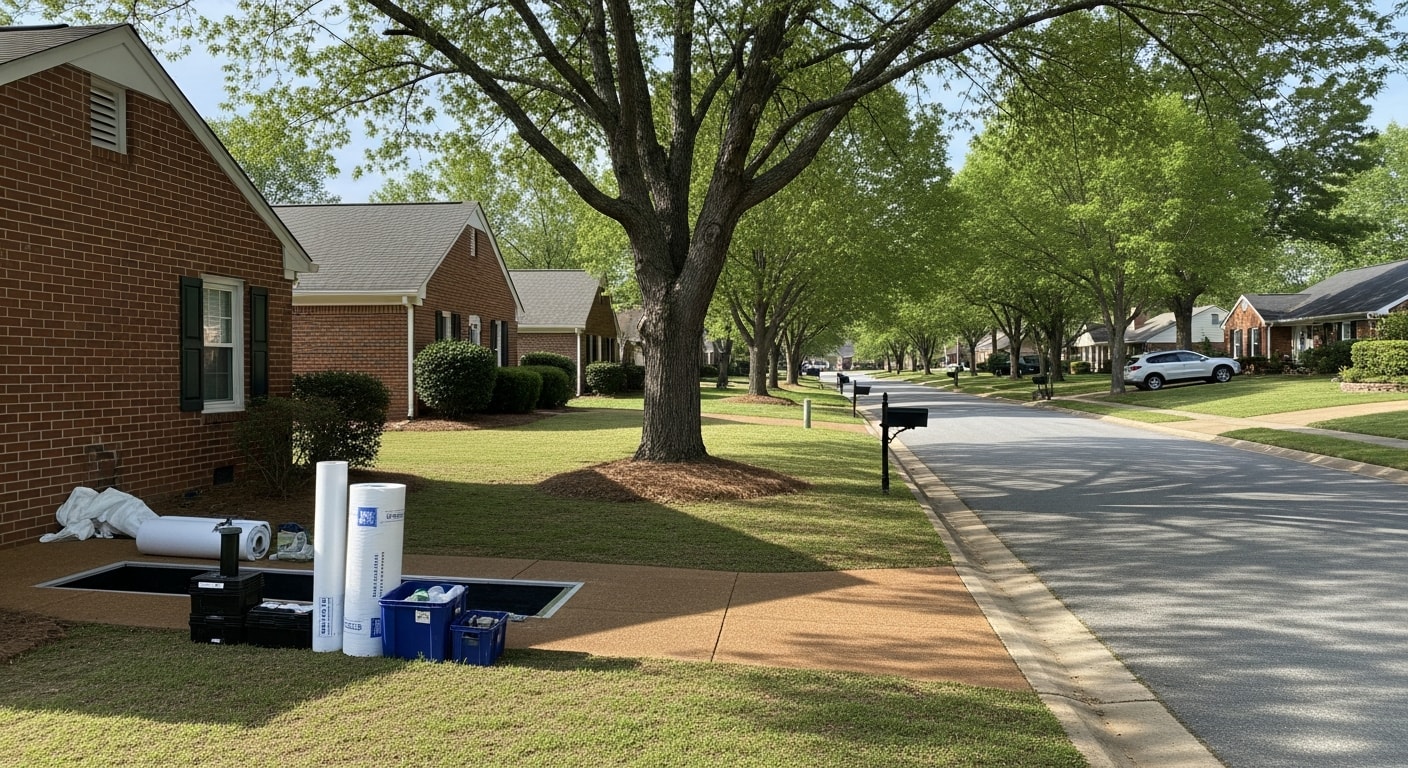
We lay perforated pipe in a bed of gravel, wrap it in filter fabric, and backfill the trench. The gravel creates a channel for water to flow. The fabric keeps soil from clogging the pipe. The pipe carries water away from your foundation to a safe discharge point—usually a drainage ditch, dry well, or street drain.
For surface drainage issues, we might add a trench drain or catch basin. For homes with downspout problems, we tie those into the system so roof water doesn’t dump next to your foundation. Every install is different because every property has different drainage patterns.
Ready to get started?
You get a system designed for local conditions. Ogburns Crossroads sits in an area where rainfall intensity has increased 21% since 1970. More rain in less time means your drainage needs to handle sudden volume. We size pipes and plan discharge points based on real storm data, not guesswork.
You get proper materials. We use commercial-grade perforated pipe, not the corrugated stuff that collapses under soil pressure. Our gravel is clean and angular so it doesn’t compact. Our filter fabric is heavy-duty landscape fabric that lasts decades, not the thin material that tears during installation.
You get installation that accounts for clay soil. That means digging deeper in some areas to reach better-draining soil layers. It means understanding how clay’s expansion-contraction cycle affects pipe placement. It means knowing when to add extra gravel or adjust the slope because clay doesn’t drain like sandy soil.
You also get honest advice about what you actually need. Sometimes a full French drain isn’t necessary. Sometimes regrading a section of yard or extending downspouts solves the problem. We’ll tell you the most cost-effective solution, even if it’s not the biggest job.
French drain installation in North Carolina typically runs $20 to $60 per linear foot. Most residential jobs in Ogburns Crossroads fall in the $23 to $36 per foot range, depending on soil conditions and how deep we need to dig.
Clay and rocky soil increase labor costs. If we’re cutting through hardpan clay or hitting rock, that takes more time and tougher equipment. Deeper trenches cost more than shallow ones. A system that needs to connect multiple downspouts or wrap around a house costs more than a simple 30-foot run along one side.
The total price depends on how many linear feet you need. A typical residential installation might be 50 to 100 feet. That puts most projects between $1,500 and $5,000. Larger properties with more severe drainage issues can run higher.
Compare that to foundation repair costs. The average water damage claim in the U.S. is around $11,000. Fixing a foundation that’s been compromised by water pressure can easily hit $15,000 or more. French drain installation is the cheaper option by a long shot.
A properly installed French drain lasts 30 to 40 years. That’s assuming it’s built right from the start—correct slope, quality materials, proper gravel bedding, and good filter fabric.
The pipe itself doesn’t wear out. What fails is usually the filter fabric if it’s low quality, or the system gets clogged because the fabric wasn’t installed correctly. Tree roots can invade pipes if they’re not deep enough or if there are gaps in the connections. Soil can wash into the gravel bed if the fabric tears.
That’s why installation quality matters more than anything else. A DIY job or a cheap install might work for five years, then start failing. You’ll see water pooling again. The system stops draining during heavy rain. At that point, you’re either digging it up to repair it or installing a new one.
We’ve seen French drains in the Greensboro area that are 20+ years old and still working perfectly. We’ve also seen systems that failed in three years because they were installed wrong. The difference is always in the details—slope, materials, and proper connection to a good discharge point.
Yes, but it requires specific installation techniques. Clay soil is the reason most homes in Ogburns Crossroads need French drains in the first place. Clay doesn’t absorb water—it holds it. That’s why you see standing water for days after a storm.
A French drain in clay soil needs to be deeper than it would in sandy soil. We’re often digging down to find a layer that drains better, or we’re going deep enough that the pipe can carry water away before it saturates the clay around your foundation. Shallow drains don’t work well in clay because the water can’t percolate down into the pipe fast enough.
We also use more gravel in clay soil installations. The gravel creates a channel where water can flow freely, even when the surrounding clay is saturated. Without enough gravel, the clay just clogs the system. The filter fabric is critical too—it needs to keep clay particles out of the gravel bed while still letting water through.
The discharge point matters more in clay soil. You can’t just dump water into your yard and expect it to soak in. We route it to a drainage ditch, street drain, or dry well where it can actually go somewhere. Otherwise, you’re just moving the problem to a different part of your property.
Absolutely, and it’s one of the smartest things you can do. Downspouts that discharge next to your foundation are a major cause of water problems. Roof runoff is concentrated—a single downspout can dump hundreds of gallons during a heavy storm.
We install underground downspout drains that tie into the French drain system. The downspout connects to solid PVC pipe that runs underground to the main drainage line. This keeps roof water away from your foundation completely. No more splash blocks, no more erosion under the downspout, no more water pooling where it shouldn’t.
This is especially important in Ogburns Crossroads because of the intense summer storms. When you get two inches of rain in an hour, your gutters are moving a lot of water fast. If that’s dumping right next to your house, it’s going straight down to your foundation. An underground connection solves that problem permanently.
Some installations use the same trench for both the French drain and downspout lines. Others require separate runs depending on your property’s layout. Either way, it’s a one-time fix that protects your foundation from both groundwater and roof runoff.
Standing water in your yard after rain is the clearest sign. If you see puddles that last more than a day, or if certain areas stay soggy while others dry out, your soil isn’t draining properly. That water is either sitting on the surface or moving toward your foundation.
Look for water stains on your foundation walls or in your crawl space. Check for efflorescence—that white, chalky residue that appears when water evaporates from concrete. Both indicate water is getting where it shouldn’t. Musty smells in your basement or crawl space mean moisture is present even if you don’t see standing water.
Watch what happens during heavy rain. Does water run toward your house instead of away from it? Do your gutters overflow because the ground can’t absorb the downspout discharge? Is there erosion around your foundation where water is washing away soil? These are all drainage problems that a French drain can fix.
Clay soil that cracks in summer and stays muddy in spring is another indicator. If your grass is dying in certain spots because the roots are waterlogged, or if you can’t use parts of your yard after rain because they’re too wet, drainage is the issue. The question isn’t whether you need better drainage—it’s whether a French drain is the right solution for your specific situation.
A French drain is buried underground and handles subsurface water. A trench drain sits at ground level and captures surface runoff. They solve different problems, though sometimes you need both.
French drains intercept groundwater before it reaches your foundation. The perforated pipe sits in a gravel bed below ground. Water seeps into the pipe through the perforations and flows away. You don’t see it—it’s completely underground. This is what you need for managing the water table around your foundation or handling water that’s moving through the soil.
Trench drains are surface drainage solutions. They’re the grated channels you see in driveways, patios, or along the edge of hardscaping. Water flows across the surface into the grate and down into a solid pipe that carries it away. These work well for areas where surface water needs to be captured quickly—like at the bottom of a sloped driveway or along a patio that’s next to your house.
In Ogburns Crossroads, we often install both. A French drain handles the groundwater issues caused by clay soil. A trench drain captures surface runoff from hard rain before it can pool. Together, they create a complete landscape drainage solution that manages water at every level.