
Contact Info
- Greensboro, NC 27406
- Call: 336-707-0498
- Text: 336-707-0498
-
Mon - Fri: 8am - 4pm
Sat - Sun: Closed
Contact Info
Two services, two very different jobs. Here's what air duct sanitizing actually does — and why the order you do things in matters more than most companies will tell you.
You turned on the AC for the first time this season and something smelled off. Maybe musty, maybe faintly moldy — just wrong. So you searched around, called a couple of companies, and now you have quotes ranging from $89 to $450 with no real explanation of what’s different between them. That’s the situation most Guilford County homeowners find themselves in, and it’s genuinely frustrating. This page is here to clear it up. We’ll explain what cleaning and sanitizing actually involve, why the sequence matters, and how to know which one you actually need.
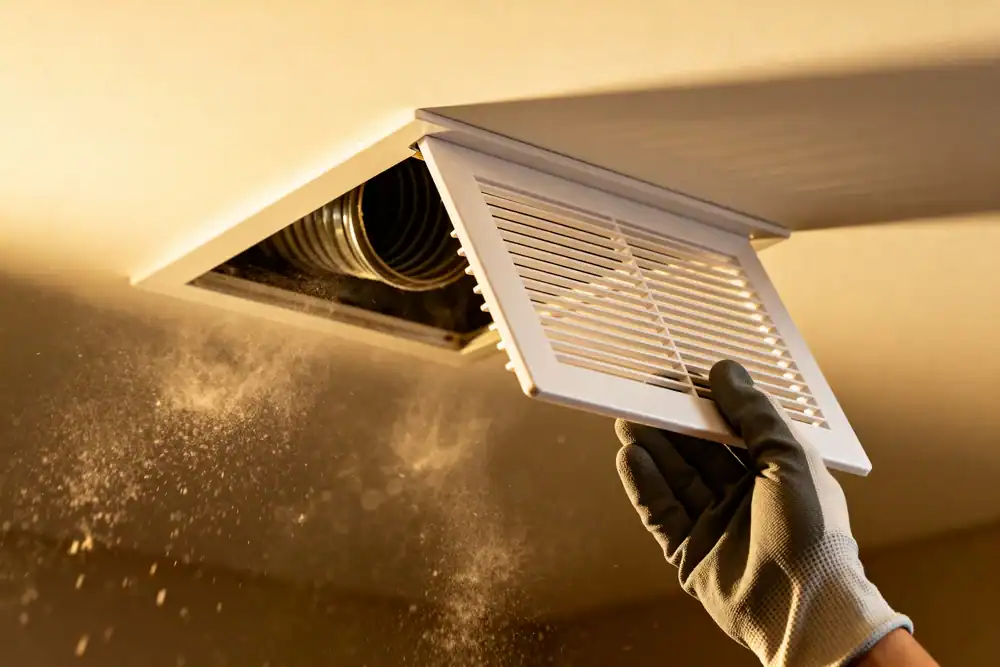
Duct cleaning is a mechanical process. The goal is to physically remove what’s built up inside your ductwork — dust, debris, pet dander, pollen, insulation particles, and whatever else has accumulated over the years. A legitimate cleaning uses powerful vacuum equipment running under negative pressure, combined with rotary brushes or agitation tools that dislodge material from the duct walls so it can be pulled out rather than pushed around.
The key word there is “removed.” Real cleaning extracts contaminants from the system. It doesn’t just blow air through the ducts or run a vacuum hose into a few registers. Your HVAC system circulates air through your home five to seven times every day, which means whatever’s sitting in those ducts is making regular rounds through every room. Cleaning addresses that at the source.
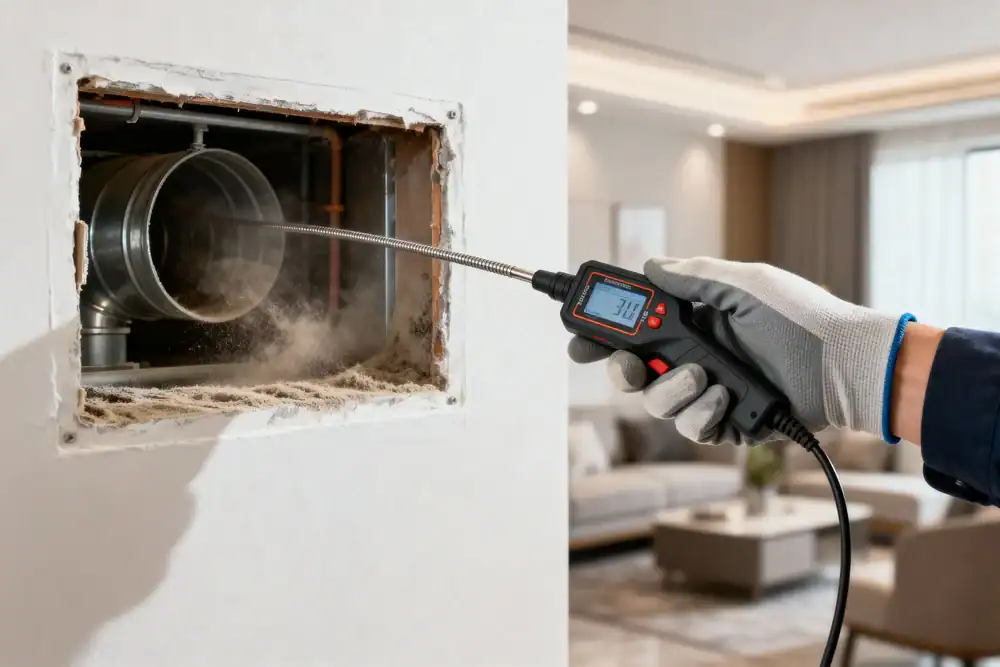
This is one of the most useful things to know before you book anyone. A legitimate residential duct cleaning — one that covers your supply ducts, return ducts, registers, grilles, and the air handler components — takes between two and six hours depending on the size of the home. Most homes we work on in Guilford County take about three to four hours.
If a company tells you they can clean your whole house in 45 minutes, that’s not a cleaning. That’s what the industry calls a “blow-and-go” — a technician runs a portable vacuum into a few accessible vents, collects a check, and leaves. The ducts look the same as before because almost nothing was actually removed. The FTC has documented this type of bait-and-switch as one of the most common home services scams in the country, and it costs American homeowners tens of millions of dollars every year.
The time benchmark is your first filter. A company willing to tell you upfront that the job takes three to four hours is a company that’s planning to actually do the job. A company that promises to be in and out in under an hour is telling you something important about what they’re actually selling.
There’s another red flag worth knowing: any quote for whole-house duct cleaning under $100 is almost certainly a scam entry point. The advertised price gets a technician in your door, and then “discoveries” get made — mold, biohazard contamination, whatever sounds alarming enough to justify a much larger bill. Legitimate full-system cleaning of a standard residential home runs $300 to $700. That’s the NADCA benchmark, and it reflects what the work actually costs when it’s done correctly.
Sanitizing is a chemical process. After the ducts have been cleaned, an EPA-registered disinfectant is applied — typically via fogging or aerosolization — to coat the interior duct surfaces and kill any remaining biological contaminants: mold spores, bacteria, viruses, fungi. Done correctly on properly cleaned ductwork, it inhibits microbial growth for roughly six months after application.
The critical word in that sentence is “after.” Sanitizing only works on clean surfaces. If a technician sprays a disinfectant into a duct that still has a layer of dust and debris coating the walls, the product can’t reach the surface it’s supposed to treat. It’s the same principle as trying to disinfect a dirty countertop without wiping it down first — the disinfectant sits on top of the grime and does almost nothing useful. Any company that offers sanitizing as a standalone service, or applies it before cleaning, is either cutting corners or doesn’t understand what they’re doing.
This is also why sanitizing isn’t always necessary. If your ducts have basic dust and debris buildup with no signs of microbial contamination — no musty odor, no visible mold, no moisture history — cleaning alone may be entirely sufficient. Sanitizing makes sense when there’s a confirmed reason for it: a persistent musty smell that cleaning alone didn’t resolve, visible mold growth inside the ductwork, a prior flood or water intrusion event, or a household with members who are immunocompromised or have serious respiratory conditions.
There’s also an important technical caveat worth knowing. The EPA has not registered any biocides for use on fiberglass duct board or fiberglass-lined ducts. If your home has that type of ductwork and there’s moisture or mold involved, the correct answer is typically replacement — not sanitizing. A technician with proper mold credentials will know this. One without them might apply a product that isn’t appropriate for your duct type, which creates a liability and doesn’t solve the problem.
Want live answers?
Connect with a Clean Air LLC expert for fast, friendly support.
The duct cleaning industry in North Carolina has no dedicated state license requirement. That means virtually anyone can buy a shop vac, print some business cards, and call themselves a professional. The result is a market full of operators at wildly different skill and equipment levels — which explains why your quotes look so different from each other.
What separates a quality job from a waste of money comes down to a few specific things: the equipment being used, the methodology being followed, and whether the company can verify their credentials through a third party. None of those things show up in an ad price.
The fastest way to filter out unqualified operators is to check NADCA membership. NADCA — the National Air Duct Cleaners Association — is the industry’s only meaningful professional organization. Their ASCS certification (Air Systems Cleaning Specialist) requires passing a rigorous exam covering HVAC systems, contamination types, cleaning methodology, and safety protocols. Members must also complete continuing education annually to maintain their certification. You can verify any company’s membership in about 30 seconds at nadca.com/find-a-professional.
This matters because NADCA’s ACR Standard requires what’s called “source removal” — physically extracting contaminants from the ductwork rather than displacing or masking them. It also requires HEPA-filtered vacuum equipment, which captures particles rather than releasing them back into your home. These aren’t optional extras. They’re the baseline for what legitimate cleaning looks like.
If sanitizing is part of what you’re considering, the relevant credential is IICRC AMRT — Applied Microbial Remediation Technician. This certification is specific to mold and microbial contamination: identifying it, containing it, and treating it correctly. Most duct cleaning companies don’t hold this credential. We do. It’s the reason we can tell you with confidence whether what’s in your ducts actually requires sanitizing — or whether cleaning alone will take care of it.
Beyond certifications, ask any company you’re considering about their process. Do they inspect with a camera before and after the job? Do they provide documentation you can keep? Do they give you a written quote after an inspection rather than a phone estimate? These aren’t unreasonable questions. A company doing the job right will have straightforward answers to all of them.
Pricing in this industry is genuinely confusing, and the range you’ll see in quotes reflects real differences in what’s being offered — not just different markups on the same service.
Nationally, most homeowners spend somewhere between $271 and $509 for a full residential duct cleaning, with the most common price landing around $389. NADCA’s own estimates for a complete system cleaning of an average-sized home run $450 to $1,000 depending on the size of the system and the level of contamination. Per-vent pricing typically runs $25 to $50 per vent. Any quote significantly below that range for a whole-house job should raise a question about scope — specifically, what exactly is being cleaned and with what equipment.
In Guilford County, a few local factors tend to affect both the need for and the cost of this service. The Piedmont’s humidity levels are genuinely high — summer relative humidity frequently exceeds 70 to 80 percent — and that moisture creates ideal conditions for mold growth inside ductwork, particularly along the cool interior surfaces of supply ducts where condensation can form. A significant portion of Guilford County’s housing stock is also built on crawl spaces rather than slab foundations, and crawl spaces in this climate accumulate moisture. Up to 40 percent of the air circulating through your home can come from the space beneath your floors. If there’s mold in your crawl space, it has a direct path into your ductwork.
Older homes in Greensboro and throughout Guilford County — particularly those built between the 1950s and 1980s — often have ductwork that has never been professionally cleaned. Those systems carry decades of accumulated debris, and they’re also more likely to have the kind of moisture history that makes sanitizing genuinely worth considering. We’ve been working in Guilford County since the early 1990s, which means we’ve seen the full range of what’s inside the homes here. That history matters when you’re trying to give someone an honest assessment rather than a sales pitch.
If you want an accurate number for your home specifically, the right starting point is an inspection — not a phone quote. A phone quote can only produce a guess. An inspection tells you what’s actually there, which is the only basis for a price that means anything.
Here’s the short version. Cleaning removes physical debris — it’s the foundation, and it has to come first. Sanitizing kills biological contaminants — it’s a targeted treatment for specific situations, not a default add-on. If you have a musty smell, a moisture history, or confirmed mold in your ductwork, sanitizing is worth it. If you have basic dust buildup and no microbial issue, cleaning alone may be all you need.
What matters most is working with someone who can tell the difference — and who will tell you honestly rather than defaulting to the more expensive option. Check NADCA membership. Ask about job duration. Get a written quote after an inspection, not before.
If you’re in Guilford County and you’d like a straight answer about what your system actually needs, we at Clean Air LLC offer free inspections as a starting point. No commitment, no manufactured discoveries — just an honest look at what’s there.
Summary:
Share: