
Contact Info
- Greensboro, NC 27406
- Call: 336-707-0498
- Text: 336-707-0498
-
Mon - Fri: 8am - 4pm
Sat - Sun: Closed
Contact Info
That musty smell is real — even if you can't see any mold. Here's what's behind it and how to actually fix it.
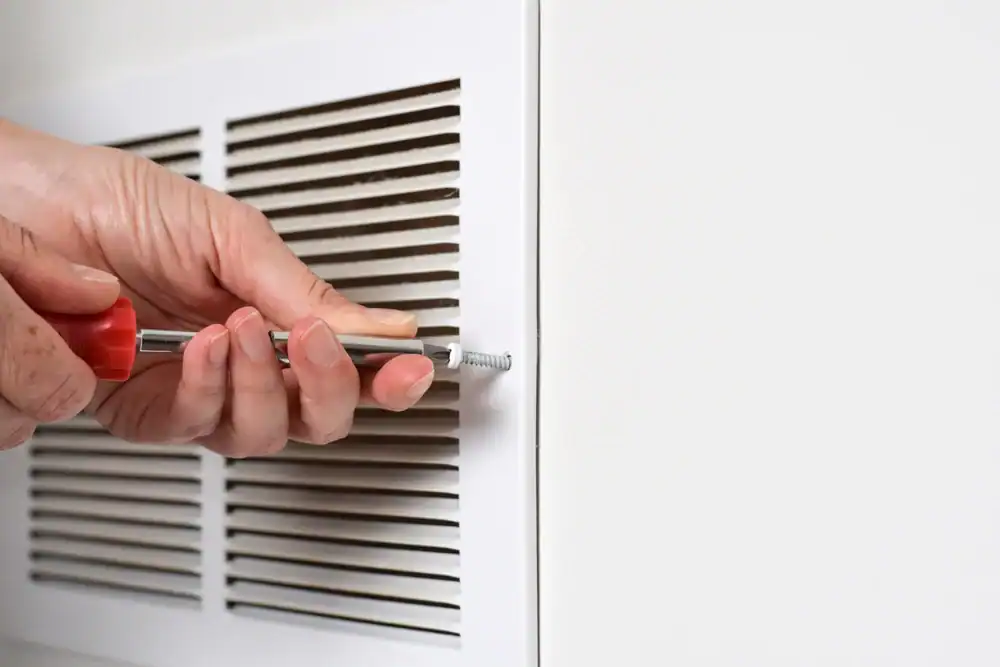
You’ve checked the bathroom. You’ve looked under the sinks. You’ve sniffed around the basement. No visible mold anywhere — but the smell is still there, and it’s not going away on its own. That’s one of the more frustrating home problems to deal with, because you know something is off but you can’t find it.
Here’s the thing: the smell and the mold don’t always show up at the same time. There’s a real scientific reason your nose can detect a problem that your eyes can’t see yet. Understanding that reason is the first step toward actually fixing it — so let’s start there.
The odor you’re detecting comes from microbial volatile organic compounds — MVOCs for short. These are gases that mold, bacteria, and other microorganisms release as they grow and metabolize. They’re airborne, they travel through your home, and your nose picks them up long before any visible colony forms on a surface.
So when your house smells musty but you can’t find mold, it doesn’t mean there’s no problem. It often means the problem is somewhere you haven’t looked yet — or somewhere you can’t easily see. Inside a wall cavity, above a ceiling panel, underneath your flooring, or deep in your crawl space.
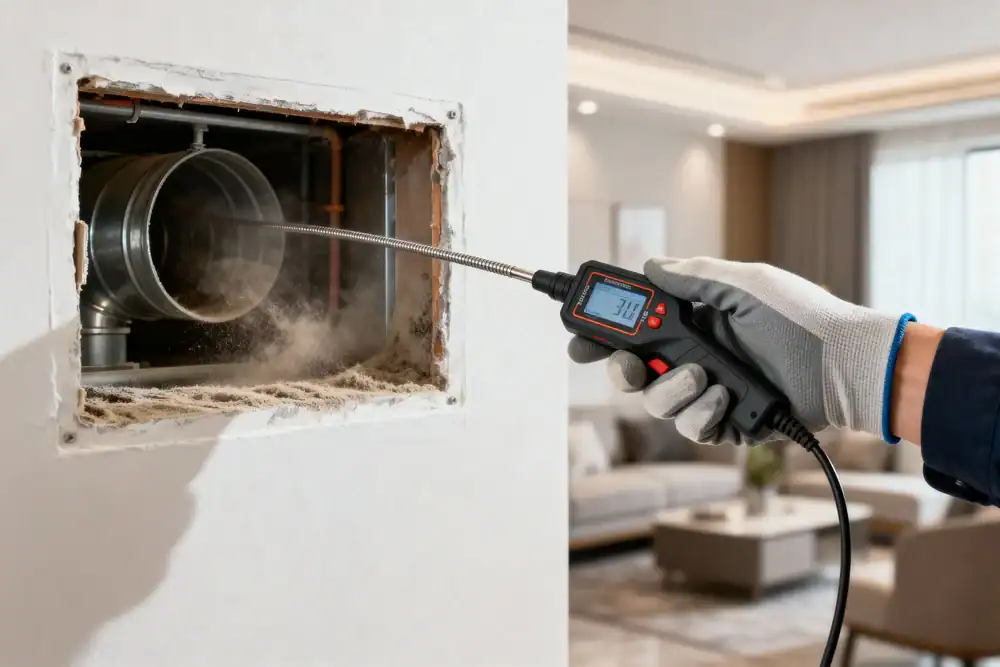
If the smell gets noticeably worse the moment your HVAC system kicks on, that’s a specific clue — and it points toward your ductwork or your AC coil as the source or the distribution channel.
There’s a phenomenon in the industry called dirty sock syndrome. It happens when microbial growth builds up on the evaporator coil inside your air handler. When the system starts running, it pushes that contaminated air through every duct in your home. The smell can hit fast and fill a room within minutes of startup, then fade slightly as the system runs — which makes it easy to dismiss as a fluke. It’s not.
Ductwork itself can also harbor biological material. Dust, moisture, and organic debris accumulate inside duct interiors over time, especially in homes where humidity has been a recurring issue. If those conditions are right — and in Guilford County, they often are — microbial growth can establish itself on duct surfaces and produce MVOCs that circulate every time the system runs.
This is also why replacing your HVAC filter doesn’t solve the problem. Filters capture particles in the airstream, but they don’t touch the interior surfaces of your ducts, your coil, or your blower components. A clean filter and a contaminated duct system can absolutely coexist.
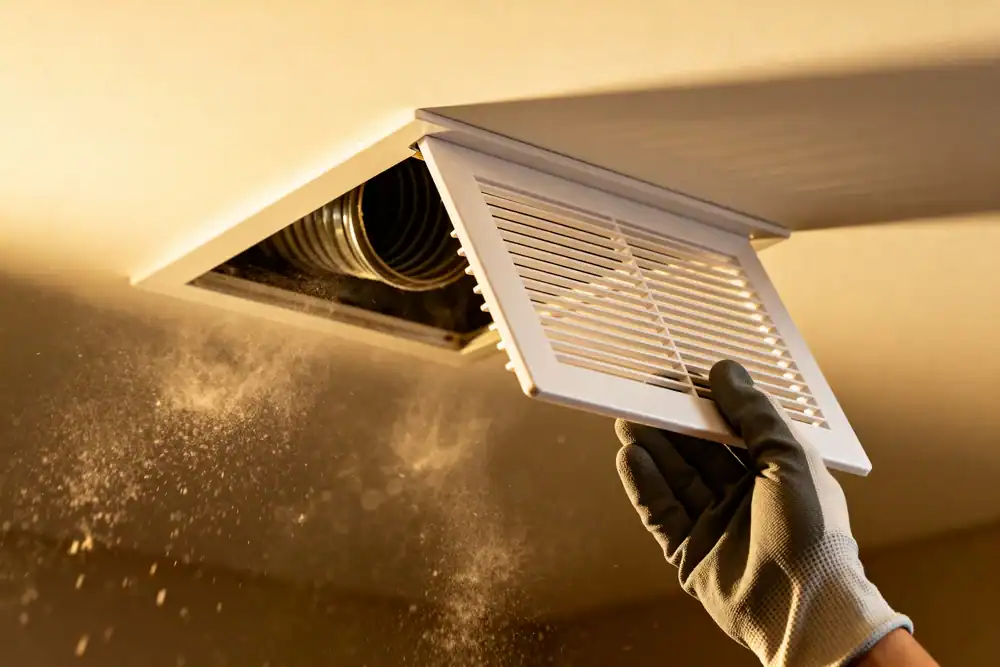
If the smell is strongest near floor vents, in rooms that get the most airflow, or immediately after the system starts, the HVAC system is worth looking at closely. That’s not a DIY fix — the coil and duct interior require professional equipment to clean properly, and doing it wrong can redistribute contaminants rather than remove them.
In Guilford County, this is the most common answer — and the one most homeowners don’t think to check first.
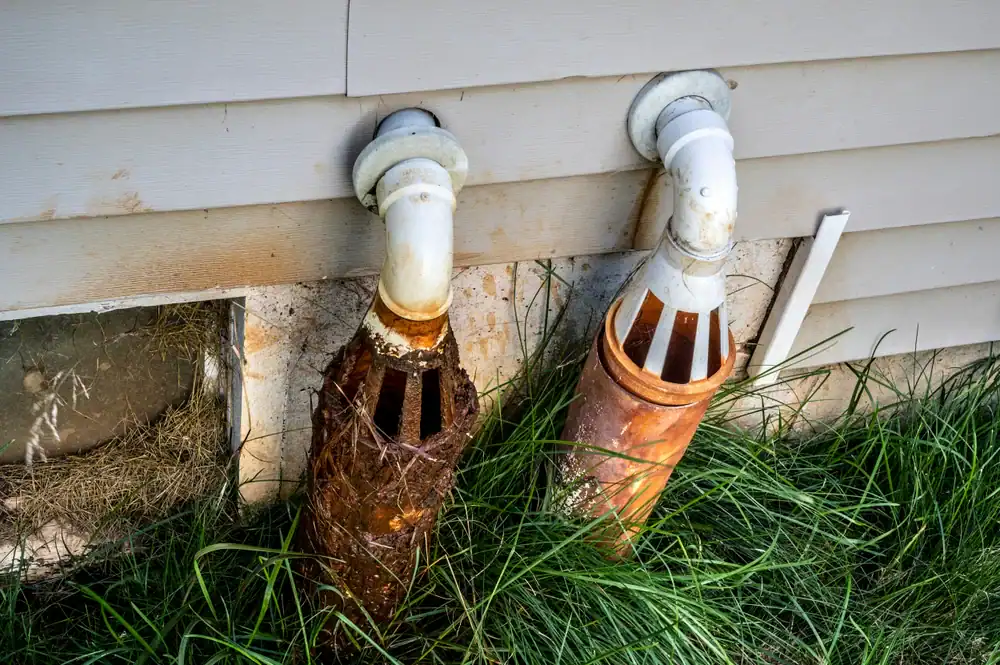
Here’s what’s happening beneath your feet: air doesn’t stay in your crawl space. It rises. Through gaps around pipes, electrical wiring, floor joists, and ductwork penetrations, crawl space air migrates upward into your living areas through a process called the stack effect. Estimates vary, but up to 50% of the air you breathe on your first floor can originate from below it. If that air is carrying MVOCs from a damp, contaminated crawl space, you’re going to smell it — even if the crawl space itself is out of sight and out of mind.
The reason this is such a persistent problem in Greensboro and the surrounding Piedmont area comes down to soil and climate. Guilford County’s clay-heavy soil holds water for days after rain. Rather than draining away, moisture saturates the ground beneath your home and slowly releases vapor upward. That vapor has to go somewhere.
In older homes — and Greensboro has a lot of them, particularly in neighborhoods like Fisher Park and Sunset Hills where homes were built between the 1900s and 1930s — crawl spaces were designed to be vented to the outside. The idea was that outdoor air would dilute the humidity inside the crawl space . In a dry climate, that logic works. In Piedmont North Carolina, it does the opposite.
Summer air in Guilford County is already carrying 70% or more relative humidity. When that warm, moisture-laden air enters a cooler crawl space, it condenses immediately. Wood framing, floor joists, and insulation stay wet. Mold can begin colonizing wood surfaces within 24 to 48 hours of sustained humidity above 60% — and from May through September, crawl space humidity in this region can sit between 70 and 85%. That’s not a brief window. That’s five months of continuous mold-favorable conditions every single year.
The smell that reaches your living room is the downstream effect of what’s happening below your floors. It’s not a ventilation problem you can solve by opening windows. In NC summers, opening windows makes it worse.
Want live answers?
Connect with a Clean Air LLC expert for fast, friendly support.
The honest answer is that it depends on where the smell is coming from and how far along the underlying problem is. Surface-level fixes work when the issue is surface-level. If you’re dealing with a musty smell that’s been present for months, comes back after every rain, or gets worse when the HVAC runs, the source is almost certainly deeper than a dehumidifier in the living room can reach.
That said, there are legitimate first steps worth taking — and knowing what they can and can’t do helps you decide when to stop troubleshooting on your own and get a professional set of eyes on it.
If the smell is mild and relatively recent, a few natural approaches can help while you work to identify the source.
Baking soda is a legitimate odor absorber — not a cover-up like an air freshener, but an actual neutralizer. Placing open containers in affected areas can reduce the intensity of the smell in the short term. White vinegar works similarly and can be applied to hard surfaces where you suspect minor biological growth. Activated charcoal is another option that absorbs odors from the air without adding fragrance.
Improving airflow helps too, with an important caveat for Guilford County residents: in the spring and fall, when outdoor air is dry and mild, opening windows and running exhaust fans is genuinely useful. In July and August, when Greensboro’s ambient humidity is at its peak, bringing outdoor air inside introduces more moisture than it removes. The EPA recommends keeping indoor relative humidity between 30 and 50 percent. If your home is consistently above that range, a properly sized dehumidifier — placed at the source, not just in a living area — can make a real difference.
The limitation of all of these approaches is that they address the air, not what’s producing the odor. MVOCs are being generated continuously as long as the biological source is active. You can absorb or dilute the gases, but unless the source is removed or the conditions that support it are changed, the smell will return. If you’ve tried natural fixes and the odor keeps coming back within days or weeks, that’s the clearest signal that something more is going on.
A few things that are commonly tried but don’t address the root cause: scented candles and plug-in air fresheners (they mask, not treat), HVAC filter replacement alone (filters don’t clean duct interiors or coils), and single-room dehumidifiers when the source is a crawl space (the moisture is being generated faster than a portable unit can remove it from the air above).
There’s no shame in trying to handle it yourself first. Most people do. But there are a few situations where continuing to troubleshoot on your own is likely to cost more time and money than it saves.
The first is persistence. If the smell has been present for more than a few weeks, or if it keeps returning after you’ve addressed the obvious candidates, the source is somewhere you haven’t found yet. That’s not a failure of effort — it’s a signal that the problem is in a location that requires equipment or access most homeowners don’t have.
The second is location. If the smell is strongest near the floor, near floor vents, in rooms above the crawl space, or immediately after your HVAC starts up, the source is almost certainly in the crawl space or the duct system. Both require professional inspection to assess properly. You can open your crawl space hatch and look in with a flashlight, but you won’t be able to see the full picture of what’s happening with humidity levels, vapor migration, or microbial growth on wood framing — and you definitely can’t see inside your ductwork.
The third is health symptoms. The CDC notes that hidden mold can trigger coughing, sneezing, and headaches — particularly in people with allergies or asthma. If anyone in your household is experiencing respiratory symptoms that seem to improve when they leave the house and worsen when they return, that’s a serious signal worth acting on quickly.
For Guilford County homeowners specifically, the combination of clay soil, humid summers, and older vented crawl space construction means that a musty smell is rarely a simple problem. It’s usually a moisture problem that’s been developing for a long time — and the longer it goes unaddressed, the more it affects the wood structure of your home, not just the air quality inside it.
A professional inspection doesn’t commit you to anything. It tells you what’s actually happening so you can make an informed decision.
A musty smell without visible mold isn’t a mystery you have to live with. The smell is real, the source is findable, and in most Guilford County homes, it comes down to moisture — in the crawl space, in the ductwork, or both. MVOCs don’t lie. If your nose is telling you something is wrong, something is wrong.
Natural fixes are worth trying if the problem is mild and recent. But if the smell keeps coming back, gets worse when your HVAC runs, or has been present for months, the source is somewhere that surface-level solutions can’t reach.
We’ve been working in Guilford County homes since 1991. We’re NADCA certified, IICRC AMRT certified, and we offer free inspections — not to sell you something, but to tell you what’s actually happening. If you want a straight answer about where the smell is coming from, that’s where we’d start.
Summary:

Share: