
Contact Info
- Greensboro, NC 27406
- Call: 336-707-0498
- Text: 336-707-0498
-
Mon - Fri: 8am - 4pm
Sat - Sun: Closed
Contact Info
If something feels off with the air in your home, a professional assessment can tell you exactly what's there — and where it's coming from.
Something’s off. Maybe the air smells faintly musty when the AC kicks on. Maybe your allergies are worse inside than out. Maybe you just moved into an older Guilford County home and want to know what you’re actually breathing before you settle in. Whatever brought you here, that instinct is worth following.
A professional air quality assessment doesn’t just confirm that something is wrong — it tells you what it is, where it’s coming from, and what it would take to fix it. Here’s what that process actually looks like, and why the source of the problem is often somewhere you’d never think to look.
When most people think about air pollution, they picture smog or exhaust — something outside. But some of the most significant sources of air pollution are inside the home, built into the materials, systems, and spaces that make up the structure itself.
Household air pollution comes from a wide range of sources: the adhesives in engineered flooring, the pressed wood in cabinetry, cleaning products, gas appliances, moisture accumulating in a crawl space, and decades of dust and biological material collecting inside ductwork that’s never been professionally cleaned. None of these things announce themselves. Most of them are odorless. Some are invisible. And when you’re breathing that air every day, the effects tend to build slowly — which is exactly why so many people live with the problem for years before connecting it to the home.
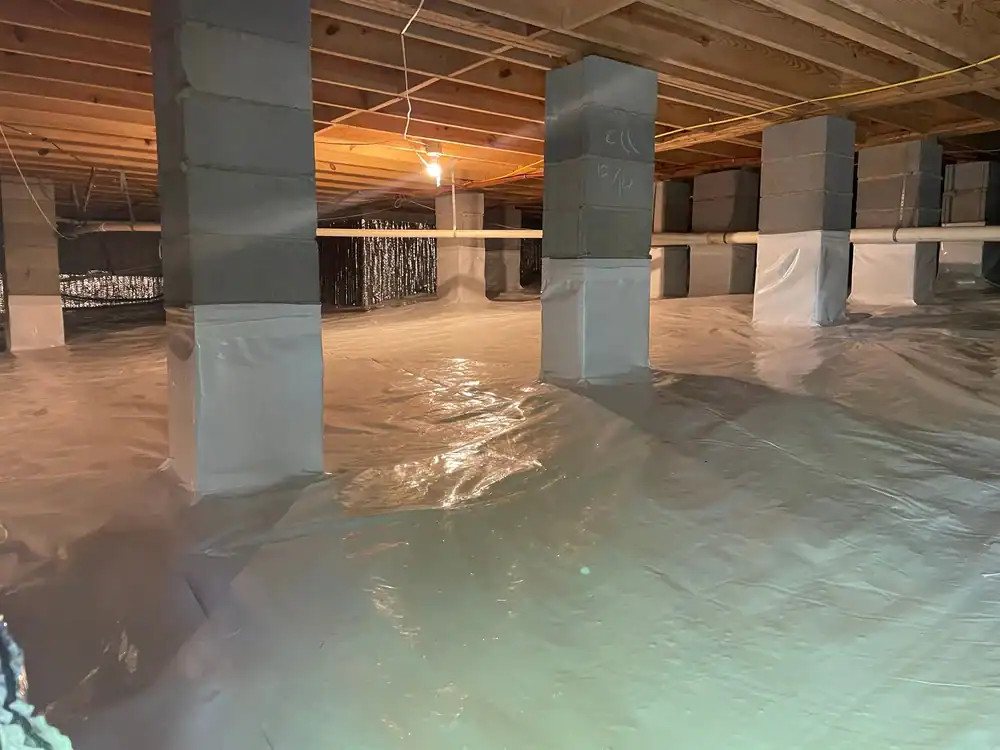
A large portion of the homes in Guilford County, NC were built between the 1940s and the 1990s. That era of construction used crawl space foundations as standard practice — and vapor barriers in those crawl spaces, if they were installed at all, have often degraded significantly over the decades. When a vapor barrier fails or was never properly installed, ground moisture moves freely into the crawl space below your home.
Here’s the part most people don’t know: up to 50% of the air you breathe on your home’s first floor originates from the crawl space below it. Warm air naturally rises and exits through the upper floors, drawing replacement air upward from the crawl space in a process called the stack effect. Whatever is in that crawl space — mold spores, moisture, soil gases, dust — gets pulled up into the living space and circulated through the HVAC system.
Guilford County’s climate makes this worse than it sounds. The Piedmont Triad sits in a humid subtropical zone, with summer humidity that regularly climbs into the 70–80% range outdoors. An unconditioned crawl space absorbs that moisture. Mold begins to grow when relative humidity stays consistently above 60%. Wood rots. Air quality inside the home deteriorates — and because the crawl space is out of sight, the connection between what’s down there and how the home feels up here rarely gets made until someone looks.
High Point’s furniture manufacturing history adds another layer. Many homes in and around High Point contain pressed wood cabinetry, engineered flooring, and particle board components that off-gas formaldehyde — a colorless, odorless VOC linked to respiratory irritation and long-term health effects. Guilford County’s warm, humid climate accelerates that off-gassing. It’s not a dramatic risk, but it’s a real one, and it’s the kind of thing a professional assessment can measure and document.
A musty odor — especially one that appears when the HVAC system kicks on — is one of the most reliable early indicators that something biological is growing somewhere in the system. Mold produces microbial volatile organic compounds (MVOCs) as a byproduct of its growth cycle, and those compounds have a distinctive earthy, musty smell. When the furnace or air conditioner turns on, it draws air through the duct system and distributes whatever is inside it throughout the home.
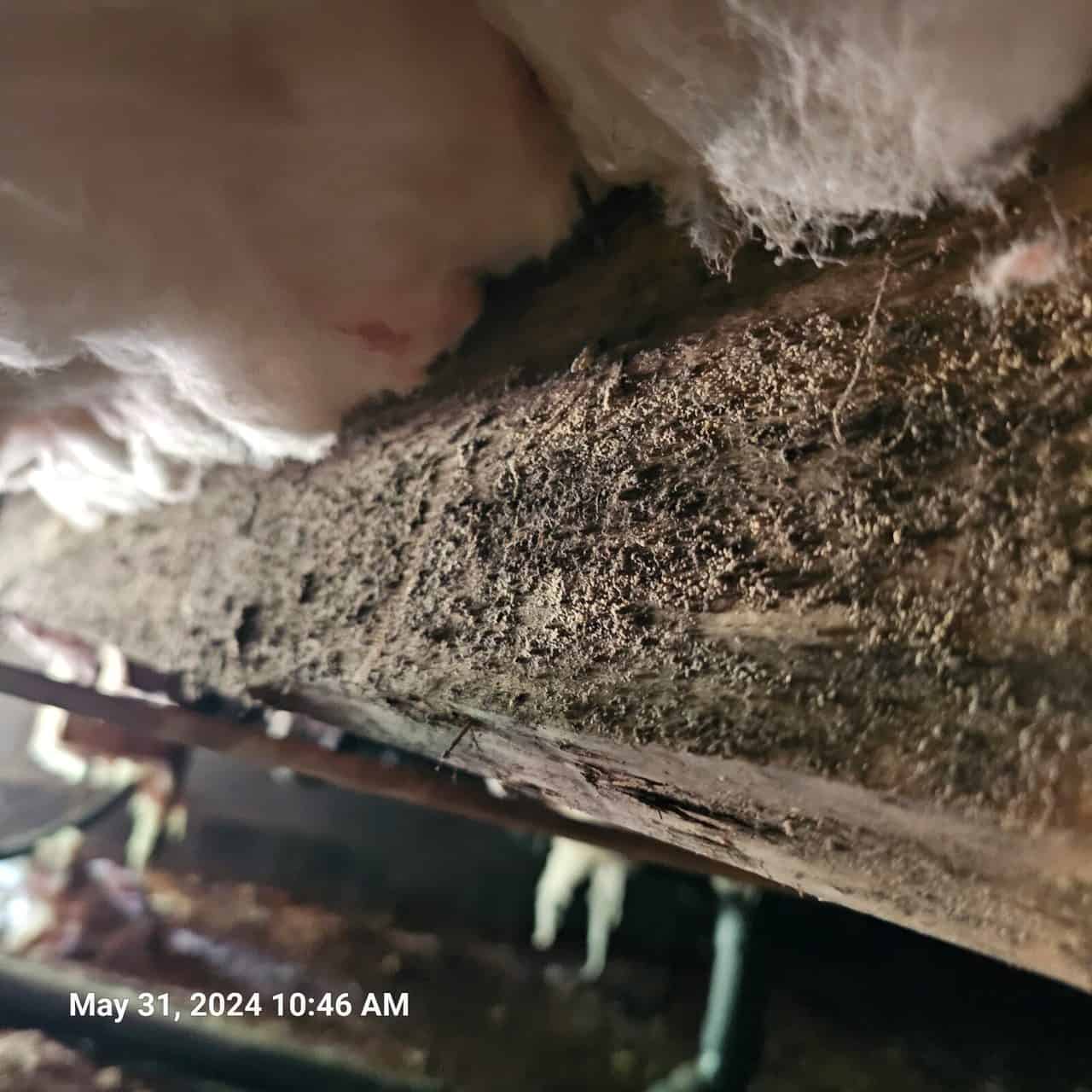
The frustrating part is that the mold producing that smell is almost never in the room where you notice the odor. It’s typically in the crawl space, inside the ductwork, around the air handler, or in some other part of the system that’s dark, damp, and rarely inspected. Spraying air freshener or replacing the HVAC filter doesn’t address any of that — it just temporarily masks the symptom while the underlying condition continues.
This is why a musty smell should be treated as a diagnostic signal, not a nuisance. It’s the home’s way of telling you something is happening somewhere you can’t see. The question isn’t whether to address it — it’s where to start looking. A professional air quality assessment answers that question by inspecting the system as a whole: crawl space, ductwork, HVAC components, and the living space together, not as isolated areas.
It’s also worth noting that the absence of a musty smell doesn’t mean the air is clean. Carbon monoxide is odorless. Radon — the second leading cause of lung cancer globally — is completely undetectable without testing. Many VOCs have no smell at all. If you’re relying on your nose as the only quality check, you’re working with incomplete information.
Want live answers?
Connect with a Clean Air LLC expert for fast, friendly support.
A professional air quality assessment covers a range of pollutants that consumer-grade air monitors can’t reliably detect. The specific scope depends on what the initial inspection reveals, but the core categories are consistent across most residential assessments.
Mold spores are typically the first priority — airborne spores from active growth in crawl spaces, inside duct systems, or behind building materials. Volatile organic compounds cover a broad category of gases emitted by paints, adhesives, cleaning products, and synthetic building materials. Carbon monoxide from gas appliances and combustion sources is measured because it’s both odorless and potentially fatal at elevated concentrations. Radon is tested separately because it requires its own sampling method. Particulate matter — fine dust, pollen, pet dander — is assessed for its load on the HVAC system and its presence in the breathing zone. And humidity levels throughout the home, including the crawl space, are documented because moisture is the root cause behind most biological contamination.
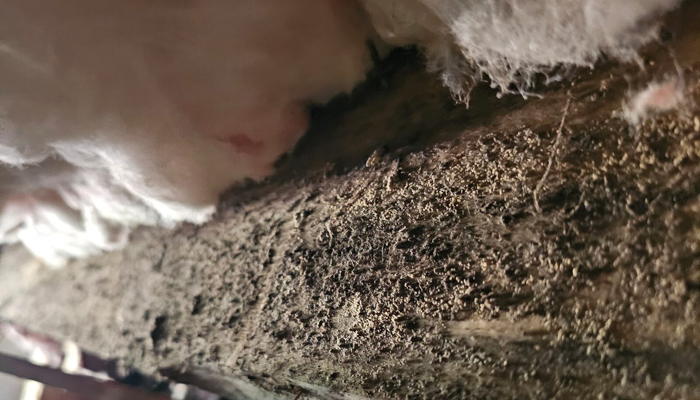
A legitimate air quality assessment starts with a visual inspection — not a sales pitch, not a quick glance, but a methodical walk-through of the areas most likely to be driving the problem. That means the crawl space, the ductwork, the air handler, and any areas of the home where moisture or contamination is suspected. The inspection comes first because it informs what sampling is actually needed.
From there, air samples are collected and sent to an accredited independent laboratory for analysis. The results are compared against established safety thresholds — the EPA’s radon action level of 4 picocuries per liter, for example, or humidity ranges known to support mold growth. A written report documents the findings with specific measured levels, not just general impressions.
What separates a thorough assessment from a superficial one is what happens next. A report that tells you mold spores are elevated is useful. A report that tells you mold spores are elevated, identifies the likely source as crawl space moisture intrusion, and outlines a remediation path — crawl space cleaning, encapsulation, dehumidifier installation — is actionable. The goal of an assessment isn’t just to confirm that a problem exists. It’s to give you enough information to fix it.
We use HEPA-filtered vacuum equipment during any remediation work, which matters more than it might sound. Standard vacuums can’t capture particles at the size of mold spores and fine allergens — they pull them in and blow them back out. HEPA filtration captures contaminants rather than redistributing them, which is the difference between actually cleaning a duct system and just moving the problem around.
Not everyone who offers air quality testing has the training to interpret what they find, and not everyone who offers remediation has the certification to do it properly. In a field where the stakes are your family’s health and the integrity of your home, credentials aren’t just resume items — they’re the mechanism by which professional standards are enforced.
NADCA certification — issued by the National Air Duct Cleaners Association — is the gold standard for duct system cleaning. NADCA-certified professionals follow strict guidelines on equipment, technique, and documentation. The certification exists partly because fraudulent duct cleaning is a documented industry problem: operators who charge for a service they don’t actually perform, using equipment that isn’t powerful enough to clean a residential duct system. NADCA certification is how you tell the difference.
IICRC AMRT certification — Applied Microbial Remediation Technician, issued by the Institute of Inspection, Cleaning and Restoration Certification — covers the mold and biological contamination side of the equation. This is the credential that governs how mold is assessed, contained, and remediated without spreading spores into unaffected areas of the home.
We hold both. Rick Watson carries NADCA ASCS and CVI (Certified Ventilation Inspector) designations. Noah Watson holds NADCA ASCS certification as well. Together, that covers the full scope of what a residential air quality assessment and remediation actually requires — duct system expertise and microbial remediation expertise under one roof. We’re also BBB accredited and have earned more than 66 five-star Google reviews from homeowners across Guilford County, NC over the course of more than 30 years in business.
The reason that combination matters is practical: if a testing-only company finds elevated mold spores in your air, you still need to find a separate contractor to fix it. We assess the problem and address it — crawl space cleaning, encapsulation, mold remediation, duct cleaning, dehumidifier installation — without handing you a report and leaving you to figure out the next step on your own.
If something about your home’s air has been nagging at you — a smell you can’t place, symptoms that get worse indoors, or just the knowledge that the crawl space and ductwork have never been looked at — a professional assessment is the straightforward way to get a real answer.
The air quality inside your home is shaped by things you can’t see from the living room. The crawl space. The duct system. The materials the home was built with. In Guilford County, NC, where the climate pushes moisture into every unconditioned space and where a large share of the housing stock has decades of history behind it, those factors add up in ways that are worth understanding.
We’ve been doing this work in Guilford County since the early 1990s, and we offer free inspections as a no-risk starting point — no pressure, no obligation, just a clear look at what’s actually going on. Reach out to Clean Air LLC and let’s find out what your home’s air is telling you.
Summary:
Share: