
Contact Info
- Greensboro, NC 27406
- Call: 336-707-0498
- Text: 336-707-0498
-
Mon - Fri: 8am - 4pm
Sat - Sun: Closed
Contact Info
DIY mold removal sounds simple until it isn't. Here's what the safety comparison between NADCA-certified abatement and going it alone actually looks like.
You found mold. Maybe it showed up on a vent register, maybe your crawl space smelled off during the last inspection, or maybe someone in your home has been coughing for weeks and you finally started connecting dots. Whatever brought you here, you’re now weighing the same question most homeowners in Guilford County land on: do I handle this myself, or do I call someone?
That’s a fair question — and the answer depends on more than cost. It depends on what’s actually at stake when mold gets disturbed without the right protocols in place. Let’s walk through it honestly.
Mold abatement isn’t just scrubbing a surface and calling it done. Done correctly, it’s a controlled process — one that starts before the first piece of mold is touched and doesn’t end until there’s verified proof the problem is gone.
The goal isn’t just to remove visible mold. It’s to do it without spreading millions of spores into the air and throughout the rest of your home. That distinction is what separates real abatement from a temporary fix.
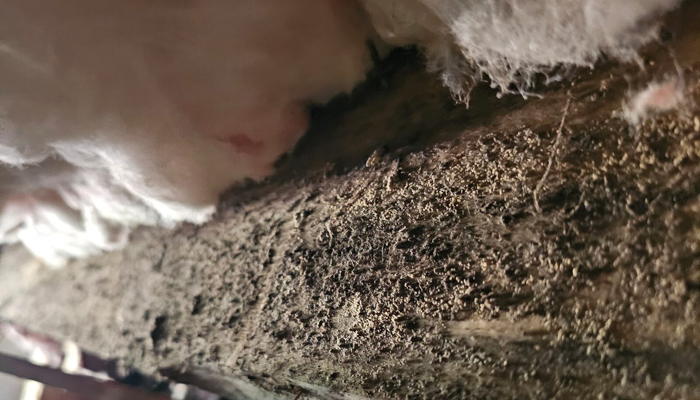
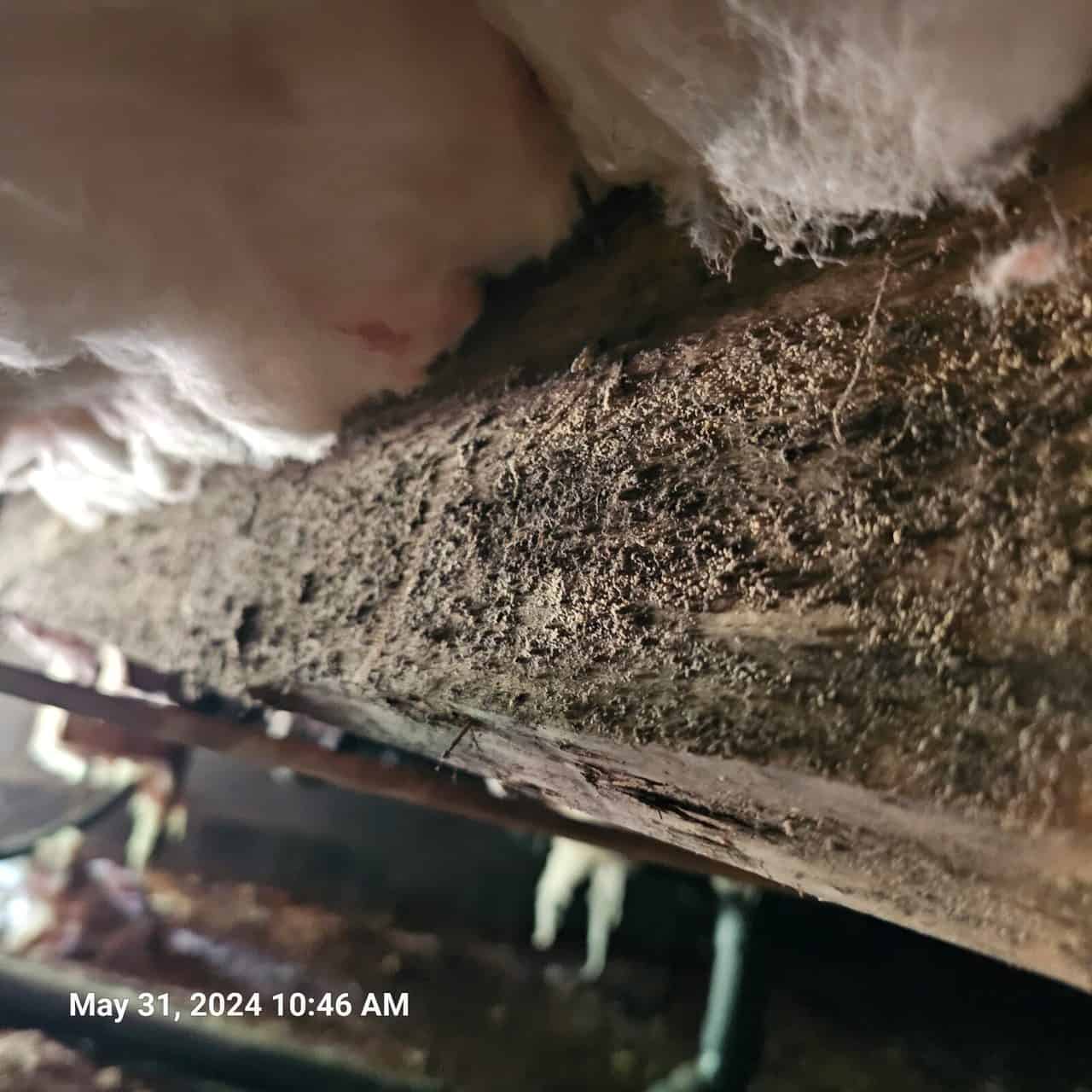
A proper mold abatement starts with assessment — not guesswork. Before anything is disturbed, we identify where the mold is, how far it extends, and what’s feeding it. Moisture meters and infrared tools find contamination behind walls and beneath flooring that you’d never see with a flashlight. In Guilford County, where clay soil holds moisture against foundations long after a rainstorm ends, hidden mold in crawl spaces is far more common than most homeowners expect.
Once the scope is clear, containment goes up. That means sealing off the affected area with poly sheeting, shutting down the HVAC system so spores can’t travel through ductwork, and establishing negative air pressure — the plastic sheeting should pull inward, not billow out — to keep disturbed spores from migrating into clean areas of the home. This step alone is what most DIY attempts skip entirely, and it’s the one that turns a contained problem into a whole-house problem.
From there, the physical removal happens using HEPA vacuums and, depending on the surface, specialized methods like soda blasting for mold embedded in wood framing. Soda blasting is particularly effective in crawl spaces because it removes mold from joists and beams without damaging the underlying wood — something wire brushes and scrubbing simply can’t replicate. Contaminated porous materials — insulation, drywall — come out in sealed bags, not shaken loose and carried through the house.
After removal, antimicrobial treatment is applied to remaining surfaces. Then comes post-remediation verification: air testing to confirm spore counts have returned to acceptable levels. A job isn’t finished because it looks finished — it’s finished when the data says it’s finished.
Most people think of mold as a surface issue — something you can see and wipe away. But when mold gets into the ductwork of your HVAC system, it stops being a localized problem and becomes a distribution problem. Every time your system runs, it’s pulling air through contaminated surfaces and pushing it into every room of your home.
The EPA is specific about this: if mold has entered the HVAC system, professional help is recommended regardless of how much visible mold you can see. That’s not a liability disclaimer — it’s because the mechanics of duct systems make DIY containment essentially impossible. You can’t seal off a duct run with poly sheeting the way you can seal off a crawl space corner.
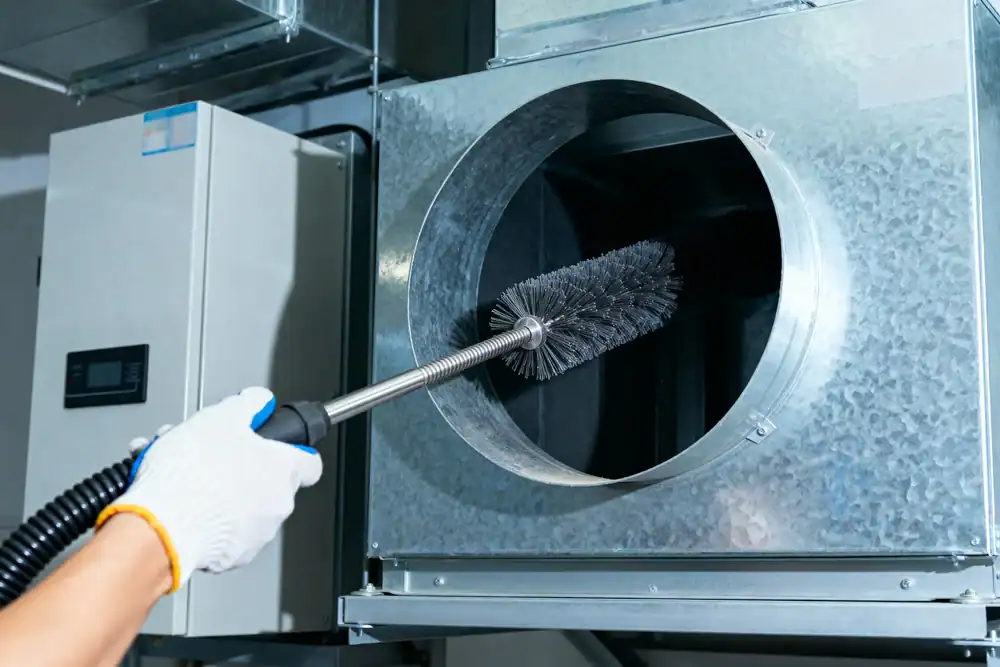
This is where NADCA certification becomes directly relevant. NADCA — the National Air Duct Cleaners Association — sets the standard for how HVAC systems should be cleaned and, when necessary, remediated. Our ACR Standard requires source removal: physically dislodging contaminants using pneumatic agitation while a high-powered vacuum simultaneously extracts what’s been disturbed. That’s not the same as spraying a duct with antimicrobial solution and hoping for the best.
In Guilford County’s older housing stock — the pier-and-beam homes in neighborhoods like Fisher Park, College Hill, and Westerwood in Greensboro — vented crawlspaces are common. Warm, humid outdoor air drawn through those vents condenses on cool crawlspace surfaces, building up a reservoir of mold and spores that migrate upward into the living space and get pulled into the duct system. Up to 40% of the air circulating through your home originates from the space beneath your floors. When that space has a mold problem, your ducts eventually do too. Treating one without addressing the other is how the problem comes back.
Want live answers?
Connect with a Clean Air LLC expert for fast, friendly support.
The EPA draws a line at 10 square feet of visible mold. Below that threshold, a healthy adult with the right PPE — a fit-tested N95 respirator, gloves, and goggles — can handle a small, isolated patch on a non-porous surface. That’s the honest answer. Not every mold situation requires a professional.
But the operative words are “small,” “isolated,” and “non-porous.” The moment mold is in your ductwork, in your crawl space, embedded in wood or drywall, or covering more than 10 square feet, the calculus changes significantly. And if anyone in your home has respiratory conditions, asthma, or a compromised immune system, professional help is recommended regardless of size.

The most common DIY approach is also the least effective one: bleach. It’s understandable — bleach removes the visible discoloration, so it looks like it worked. But on porous surfaces like wood, drywall, or insulation, bleach doesn’t penetrate deep enough to reach mold’s root structure. The surface looks clean. The mold keeps growing underneath.
Worse, bleach is mostly water. On porous materials, that moisture content can actually encourage further mold growth once the surface dries. You’ve removed the stain and fed the problem at the same time.
The other issue with DIY is containment — or the lack of it. Scrubbing mold without sealing off the area first releases spores into the air. Those spores travel. They land in other rooms, settle into carpet and upholstery, and get pulled into the HVAC system where they find new surfaces to colonize. A study of DIY mold removal outcomes consistently shows that disturbing mold without proper negative pressure containment spreads contamination beyond the original affected area. What started as a patch in the corner of the crawl space becomes a problem in three rooms.
The PPE requirements alone tell part of the story. For mold remediation covering 10 to 30 square feet — what the industry classifies as Level 2 — the minimum protective equipment includes a fit-tested N95 respirator, disposable Tyvek coveralls, gloves, and goggles. Most homeowners attempting DIY removal use a paper dust mask and old clothes. It’s just the gap between what feels adequate and what the safety standards actually require.
Choosing the wrong contractor for mold abatement isn’t just a money problem — it’s a health problem. In Guilford County, there are documented cases of contractors who took payment and never completed the work. In a market where mold abatement can run anywhere from $1,500 to over $9,000 depending on scope, that’s a significant risk.
NADCA certification is one of the clearest ways to separate qualified companies from unqualified ones. To be a NADCA member, a company must have at least one ASCS — Air Systems Cleaning Specialist — on staff. That credential requires passing a written exam demonstrating a thorough understanding of HVAC systems and NADCA’s ACR Standard. Our team includes both Rick Watson (ASCS, CVI) and Noah Watson (ASCS). The CVI — Certified Ventilation Inspector — is a higher-level credential that qualifies a technician to inspect HVAC systems according to federal and national standards. Not every NADCA member company has a CVI on staff.
BBB accreditation adds another layer of accountability. It requires a business to pass a vetting process and agree to the BBB’s standards for trust — something that matters in a service category where fly-by-night operators are a real concern.
We’ve been serving Guilford County since 1991. That’s more than 30 years of residential work in Greensboro, High Point, Jamestown, Summerfield, and the surrounding communities. We understand the specific conditions here — the Piedmont humidity, the clay soil that holds moisture against foundations long after it rains, the aging crawlspaces in mid-century homes across the Triad — because we’ve been working in these homes for decades. Our 66+ five-star reviews aren’t from a national customer base. They’re from your neighbors.
We offer free inspections. You don’t have to commit to anything to find out what you’re actually dealing with. If the problem is small enough to handle yourself, we’ll tell you that. If it needs professional abatement, you’ll know exactly what’s involved and why before any work begins.
If the mold is small, on a non-porous surface, and you’re in good health, a careful DIY approach with proper PPE is a reasonable option. That’s the honest answer. But if the mold is in your ducts, in your crawl space, embedded in wood or drywall, or you’ve already tried treating it and it came back — that’s when professional abatement is the right call, not just a more convenient one.
The safety gap between a properly contained, NADCA-certified abatement and a DIY attempt isn’t about credentials for their own sake. It’s about containment, source removal, and verification — the three things that determine whether the problem is actually resolved or just temporarily invisible.
If you’re in Greensboro, High Point, or anywhere across Guilford County and you want a straight answer about what you’re dealing with, reach out to us. We’ll take a look, give you an honest assessment, and let the facts drive the conversation from there.
Summary:
Share: