
Contact Info
- Greensboro, NC 27406
- Call: 336-707-0498
- Text: 336-707-0498
-
Mon - Fri: 8am - 4pm
Sat - Sun: Closed
Contact Info
Not sure whether your crawl space needs a vapor barrier or full encapsulation? Here's how to tell the difference — and make the right call for your home.
If you’ve been researching crawl space moisture problems, you’ve probably run into the terms “vapor barrier” and “encapsulation” used as if they mean the same thing. They don’t. One is a floor-level moisture shield. The other is a complete sealed environment. Choosing the wrong one doesn’t just waste money — it can leave your crawl space just as vulnerable as before.
We’ve been working under Guilford County homes since the early 1990s, and this confusion comes up constantly. So let’s clear it up. Here’s what each option actually does, when one is enough, and when you really do need the other.
A vapor barrier is a sheet of polyethylene plastic — typically 6 to 20 mil thick — laid across the dirt floor of your crawl space. Its job is to block ground moisture from evaporating upward into the space. It’s a meaningful improvement over a bare dirt floor, and in the right conditions, it’s a legitimate solution.
Full encapsulation goes further. It seals the crawl space floor and walls with a continuous heavy-duty liner, closes off foundation vents, and usually pairs the system with a dehumidifier to actively control humidity. The goal isn’t just to slow moisture — it’s to create a conditioned space that stays dry regardless of what’s happening outside.
The distinction matters because one addresses vapor rising from the ground, while the other addresses all the ways moisture enters a crawl space — including through vented walls and humid outdoor air.
There’s a widespread belief that crawl space vents are a good thing — that they let moisture escape. In dry climates, that logic holds. In Guilford County, it works against you.
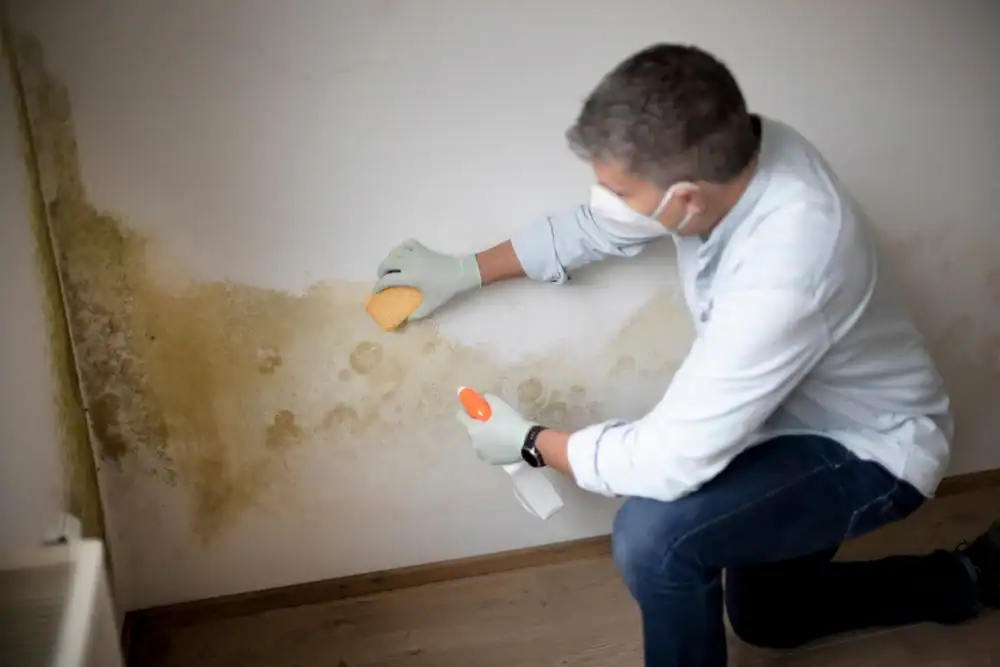
Greensboro averages around 46 inches of rain per year, and summer humidity regularly climbs above 70 to 80 percent. When that warm, saturated outdoor air flows through foundation vents into a cooler crawl space, it condenses on the wood framing, insulation, and dirt floor. You’re not venting moisture out — you’re inviting it in. That’s the environment where mold takes hold within 24 to 48 hours of moisture exposure, and where wood rot quietly gets started on floor joists that are holding up your living room.
This is why sealed crawl spaces consistently outperform vented ones in the Southeast. It’s not a sales pitch — it’s building science. The stack effect means air naturally rises from the lowest point of your home upward through living spaces. Studies have found that up to 40 percent of the air in a home can come from the crawl space. If that air is carrying mold spores and humidity, it’s moving through your ductwork and into the rooms where your family spends most of their time.
Guilford County’s soil adds another layer to the problem. The area’s predominant Cecil sandy clay loam holds moisture well and can become saturated after heavy rain, pushing ground moisture into crawl spaces from below. Many neighborhoods in Greensboro — particularly older ones like Fisher Park, Lindley Park, and Westerwood — sit on sloped terrain where water naturally drains toward foundations. A basic vapor barrier handles the ground moisture piece. But if water is also entering through walls or foundation vents, a vapor barrier alone won’t be enough.
A lot of homeowners assume a vapor barrier is just plastic sheeting tossed on the ground. When it’s done that way, it usually fails within a few years — edges curl up, seams separate, and moisture finds its way through every gap.
Done properly, a vapor barrier installation starts with clearing the crawl space of debris, old insulation, and any standing water before a single piece of material goes down. The barrier itself should be a minimum of 6 mil — that’s the NC building code floor — but professional-grade installations typically use 8 to 20 mil reinforced material that resists punctures and lasts significantly longer. Seams need to overlap by at least 12 inches and be fully taped. The edges need to run up foundation walls and be mechanically fastened, not just folded over. Every penetration — pipes, piers, utility lines — needs to be sealed individually.
When those steps are skipped, you end up with a barrier that looks complete from a distance but has enough gaps to let moisture continue doing damage. This is one of the clearest differences between a professional installation and a DIY attempt with material from a home improvement store.
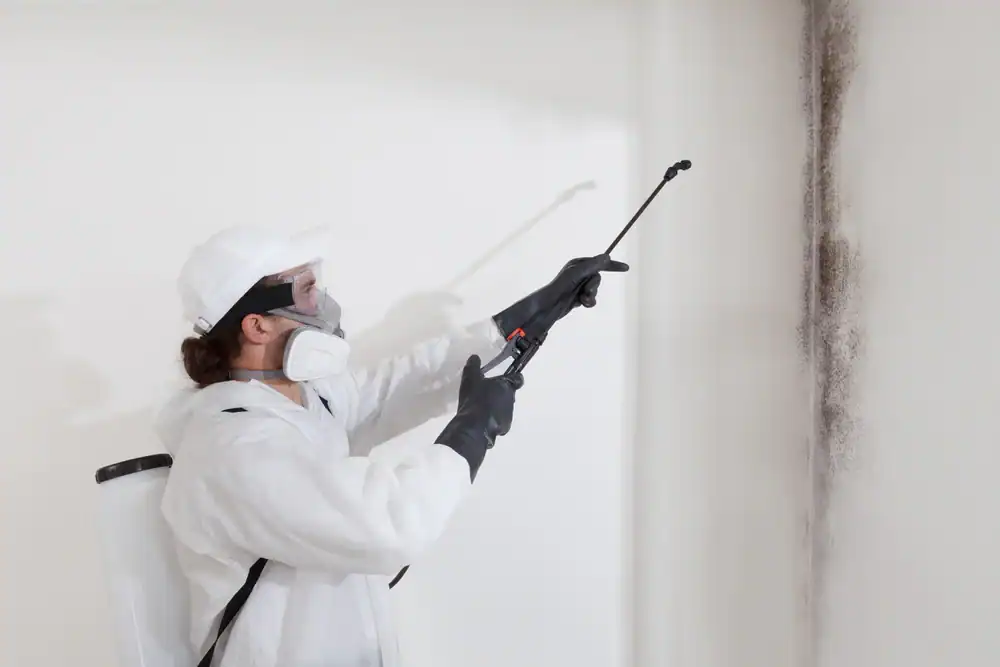
If mold is already present in the crawl space, it has to be properly remediated before any barrier or encapsulation system goes in. Sealing over active mold doesn’t eliminate it — it traps it. We use soda blasting to remove mold from wood framing and surfaces before encapsulation, which is an approach most general contractors don’t offer. It’s effective, eco-friendly, and it means you’re not just covering a problem — you’re actually resolving it.
The right thickness and installation method depend on your specific crawl space conditions, which is why a thorough inspection before any work begins isn’t optional — it’s the only way to make sure you’re solving the right problem.
Want live answers?
Connect with a Clean Air LLC expert for fast, friendly support.
Full encapsulation costs more upfront than a basic vapor barrier — typically in the range of $3 to $10 per square foot depending on the size of the space, drainage needs, and whether any structural repairs are required. For a lot of Guilford County homeowners, that number gives them pause.
But the comparison isn’t just installation cost versus installation cost. It’s what each system actually delivers over time, and what you’re likely to spend if you choose the less comprehensive option and it falls short.

Properly sealed crawl spaces can reduce heating and cooling costs by 15 to 20 percent. In a climate like Guilford County’s — where summers are long and humid and winters are damp enough to drive cold air up through uninsulated floors — that’s a real and measurable difference on your utility bill, not a marketing estimate.
Cold floors in winter are one of the most common complaints we hear from homeowners in older Greensboro neighborhoods. It’s especially common in High Point’s mid-century housing stock, where crawl spaces have been exposed to decades of Piedmont humidity without any moisture protection. The floor feels cold because the crawl space beneath it is cold and damp, and there’s nothing between that air and your living space. Encapsulation, combined with insulation on the foundation walls, creates a thermal buffer that makes a noticeable difference in comfort — not just air quality.
There’s also the structural side of the equation. Moisture-damaged floor joists in older homes can cost anywhere from $2,000 to $15,000 to repair, depending on how far the damage has spread. Encapsulation doesn’t just protect air quality — it protects the wood that holds your home up. For homes in Greensboro’s historic neighborhoods, where the framing is already 60, 80, or 100 years old, that protection is worth taking seriously.
A dehumidifier is almost always part of a complete encapsulation system in this region, because even a well-sealed crawl space can accumulate humidity without active moisture management. Sized correctly for the space and set to maintain relative humidity below 60 percent, a crawl space dehumidifier is what keeps the system working year-round rather than just at installation.
This is the question most homeowners are really asking when they search for crawl space solutions. And the honest answer is that it depends on what’s actually happening in your crawl space — which is why a professional inspection matters more than any general rule.
That said, there are some reliable patterns. If your crawl space has a dirt floor, no existing moisture barrier, and you’re dealing with a musty smell or elevated indoor humidity, a properly installed vapor barrier can make a meaningful difference — especially if your foundation vents are functioning and you don’t have active water intrusion. It’s a cost-effective starting point for homes where moisture is coming primarily from the ground.
If you’re seeing visible mold on wood framing, dealing with standing water after rain, noticing cold floors or high energy bills, or you’ve had a home inspector flag the crawl space, those are signs that a vapor barrier alone probably won’t be enough. Active water intrusion requires drainage solutions — a sump pump, a French drain, or both — before any barrier system goes in. In Guilford County, where sloped terrain and clay-heavy soil push water toward foundations, drainage is a more common part of the conversation than many homeowners expect.
For homes in Greensboro that were built before 1980, the crawl space was almost certainly designed as a vented space. That design made sense under older building standards. Under current understanding of how humid climates actually behave, it’s a liability. Full encapsulation — closing the vents, sealing the walls, installing a dehumidifier — converts that vented space into a conditioned one. It’s a more involved project, but it’s also the approach that holds up over time.
We offer free inspections because we think the right answer should come from seeing your specific crawl space, not from a general recommendation made over the phone. A real inspection tells you what’s causing the moisture, where it’s coming from, and which solution actually addresses the source — not just the symptom.
A vapor barrier and full encapsulation both have their place. The mistake is treating them as interchangeable or assuming the cheaper option is always sufficient — or that the more expensive one is always necessary. The right answer depends on your crawl space, your home’s age, your soil conditions, and what’s actually driving the moisture problem.
What we know after more than 30 years working under Guilford County homes is that the problems people ignore tend to get more expensive over time. Mold spreads. Wood deteriorates. Air quality suffers quietly. And the cost of fixing what’s been damaged usually exceeds what prevention would have cost.
If you’re dealing with a musty smell, cold floors, visible mold, or a home inspector’s report you’re not sure how to act on, we offer free crawl space inspections. No pressure, no guesswork — just a clear picture of what’s happening and what it would take to fix it.
Summary:
Share: