
Contact Info
- Greensboro, NC 27406
- Call: 336-707-0498
- Text: 336-707-0498
-
Mon - Fri: 8am - 4pm
Sat - Sun: Closed
Contact Info
That post-rain smell coming from your basement isn't just unpleasant — it's a signal. Here's what it actually means for your home.
You walk downstairs the morning after a Greensboro thunderstorm and it hits you immediately — that damp, stale smell that wasn’t there before. Or maybe it’s been building for weeks and the rain just made it worse. Either way, something’s off, and you know it.
The good news is that the smell itself is useful information. It’s telling you something specific about what’s happening in your home’s lower levels. The tricky part is knowing what it means and what, if anything, you should actually do about it. That’s what we’re going to walk through here.
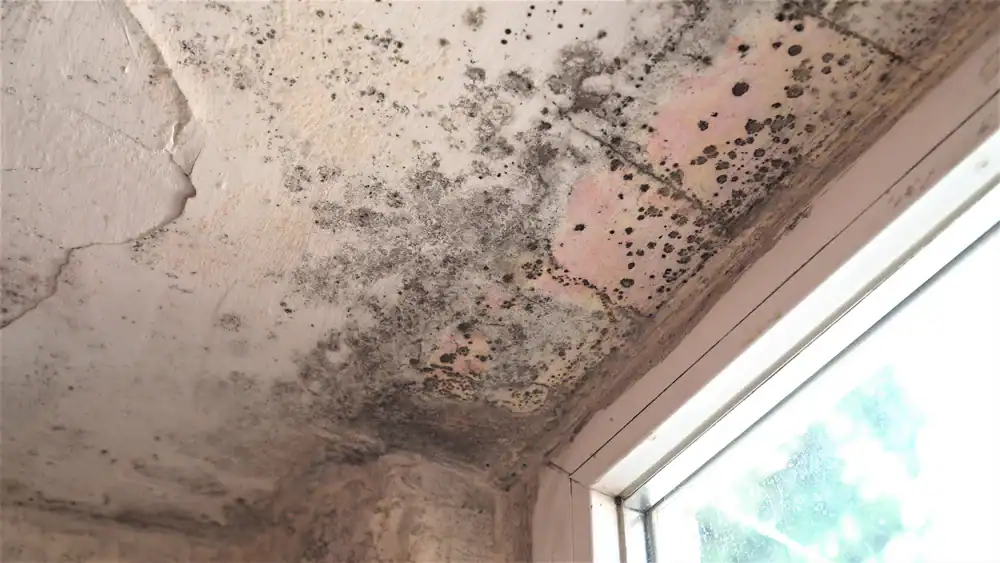
The musty smell most homeowners notice isn’t random — it has a chemical source. When mold and mildew grow on organic materials like wood, drywall, or insulation, they release gases called Microbial Volatile Organic Compounds, or MVOCs. Those are what you’re actually smelling. It’s not just dampness. It’s a biological process happening somewhere in your home’s structure, and the odor is the byproduct.
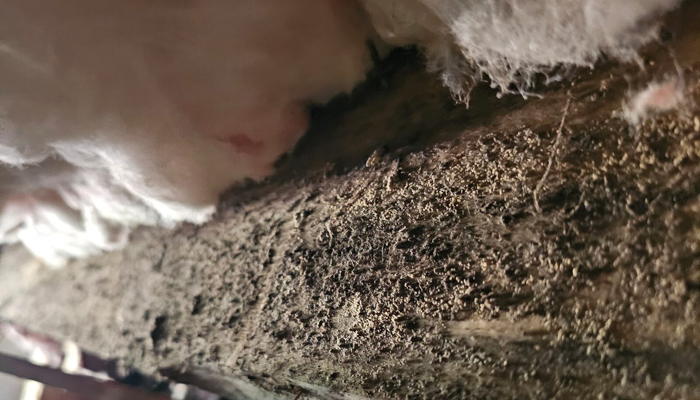
What makes this tricky is that you don’t need standing water for mold to grow. Wood framing, insulation, and even cardboard boxes act like sponges — they absorb moisture, stay damp longer than you’d expect, and quietly support mold growth without ever showing visible water on the floor. The smell is often the first warning sign, not the last.

Here’s what’s actually happening when the smell spikes after a storm. Guilford County sits on clay-heavy Piedmont soil — the kind that doesn’t drain quickly. When a significant rain event hits Greensboro or High Point, that soil becomes saturated fast. The water has nowhere to go, so it presses against your foundation walls and crawl space floor.
Even without a visible crack or active leak, moisture moves through porous concrete and mortar joints. It doesn’t need a gap to get in — it seeps. Once that moisture reaches the organic materials inside your crawl space or basement — wood joists, insulation batts, old cardboard, even the dirt itself — it creates the conditions mold needs to activate or accelerate. Mold can begin growing within 24 to 48 hours of materials staying wet. So a heavy Thursday rain can mean a noticeably worse smell by Saturday morning.
This is also why the smell can feel sudden even when the underlying problem isn’t. Dormant mold colonies that have been sitting in your crawl space for months can become active again after a rain event, releasing a fresh wave of MVOCs. The rain didn’t create the problem — it revealed it.
North Carolina adds another layer to this. Greensboro receives around 46 inches of rainfall annually, spread across the full year with no real dry season. There’s no summer drought that gives your crawl space a chance to dry out completely. The Piedmont Triad’s humid subtropical climate means relative humidity regularly climbs above 70 to 80 percent during summer months, which keeps below-grade spaces chronically damp even between rain events.
If your home was built before the 1990s with a vented crawl space — which describes a large portion of Guilford County’s housing stock — that design was never built to handle North Carolina’s moisture load the way we now understand it should be. Older homes in High Point, Greensboro, and surrounding areas are particularly vulnerable to this pattern.
If you’re noticing the musty smell in your bathroom and not just the basement, that’s worth paying attention to separately — because the cause might be the same problem traveling a different route.
Bathrooms have their own potential mold sources: grout lines in the shower, the area behind drywall if a slow leak has been going on, or an exhaust fan that’s not moving enough air. Those are worth checking. But if the smell is new, came on suddenly, and your home has a crawl space, there’s a good chance the source isn’t in the bathroom at all.
Here’s the mechanism: warm air naturally rises through a home and escapes through upper levels, which pulls replacement air up from below — this is called the stack effect. Building scientists estimate that up to 50 percent of the air you breathe on your first floor comes from your basement or crawl space. That air travels upward through gaps in the floor structure, through wall cavities, and into your HVAC system.
When your air conditioner kicks on — especially for the first time in spring — it pulls air through the duct system. If those ducts pass near or through a mold-affected crawl space, or if mold has grown on the HVAC coil itself, that contaminated air gets distributed to every room in the house. Including your bathroom.
This is sometimes called “dirty sock syndrome” — a term HVAC technicians use when microbial growth on the AC coil creates a sour, musty odor that blows through the vents whenever the system runs. It’s distinct from a basement smell but connected to the same root cause: moisture getting somewhere it shouldn’t and biology doing the rest.
The practical takeaway is this: if the smell in your bathroom came on suddenly and you haven’t found an obvious local source like visible mold on grout or a leaking pipe, don’t spend too long chasing it in the bathroom itself. The answer may be below your feet.
Want live answers?
Connect with a Clean Air LLC expert for fast, friendly support.
A lot of homeowners try a dehumidifier first, and it makes sense — you’ve identified moisture as the problem, so removing moisture from the air seems logical. The issue is that a dehumidifier manages ambient humidity but can’t eliminate mold that’s already established in your materials. It’s the equivalent of running a fan in a room with a slow gas leak. The air might feel better temporarily, but the source is still active.
Air fresheners and odor absorbers follow the same logic — they mask the smell without touching the MVOCs being produced at the source. The mold keeps growing, the gases keep releasing, and eventually the smell comes back.
One of the most common misunderstandings we see is homeowners treating a musty basement smell as a contained problem — something happening only in the basement that stays in the basement. The stack effect makes that impossible. Because air moves upward through your home continuously, whatever is in your crawl space is also, to a significant degree, in your living space.
Up to 40 percent of the air circulating through your home comes from the space beneath your floors. When that space has active mold growth, mold spores and MVOCs travel with the air. They reach your HVAC system, get pulled into the duct system, and get distributed to every room. This is why families sometimes notice allergy symptoms or a general stuffiness that they can’t quite explain — they’ve been attributing it to outdoor pollen or seasonal changes when the actual source is directly under their house.
This also means that addressing only the crawl space — without checking whether the duct system has become contaminated — can leave half the problem in place. And addressing only the ducts without fixing the moisture source in the crawl space means the contamination will return. The two systems are connected, and a complete solution has to treat them that way.
We hold both IICRC AMRT certification — the Applied Microbial Remediation Technician credential, which is the same mold-specific standard now referenced by federal law for military housing remediation — and NADCA certification for air duct cleaning. That combination isn’t common among local contractors in Guilford County, and it matters precisely because musty smell problems in our area rarely live in just one place.
Not every musty smell requires a major remediation project. Sometimes it’s a simple moisture pathway that can be corrected with drainage improvements or better vapor control. Other times, mold has been growing in the crawl space for long enough that a more thorough approach is needed. The only way to know which situation you’re in is to actually look.
A few signs that point toward getting a professional involved sooner rather than later: the smell is present consistently, not just right after rain; it’s migrated from the basement into your main living areas or HVAC vents; you’ve already tried a dehumidifier and the smell returned; or you’ve noticed anyone in the household dealing with unexplained allergy symptoms or respiratory irritation at home. Any of those patterns suggests the problem has moved beyond ambient humidity into active mold growth.
For Guilford County homeowners specifically, the combination of clay soil, year-round rainfall, and older vented crawl space construction creates conditions where moisture problems tend to be chronic rather than one-time events. A single dry spell won’t reset the situation. The long-term answer for most homes in our area with this profile is a sealed, encapsulated crawl space with active humidity control — but getting there starts with understanding exactly what you’re dealing with.
We offer free inspections with no obligation. That means you can get a professional assessment of your crawl space and duct system — what’s actually in there, where the moisture is coming from, and what a realistic fix looks like — without committing to anything. For most homeowners, that inspection is the moment the picture finally becomes clear. You stop guessing, and you start working from real information.
That post-rain smell is worth taking seriously — not because it automatically means a crisis, but because it means something is happening that won’t resolve on its own. In Guilford County’s climate, moisture finds its way into below-grade spaces reliably and repeatedly. The homes that handle it well are the ones where someone looked at the problem directly instead of hoping it would clear up.
If the smell is new, sudden, or getting worse, the most useful thing you can do is get eyes on the actual source. Not a YouTube diagnosis, not another dehumidifier — a real look at the crawl space and duct system by someone who knows what they’re looking at.
Clean Air LLC has been serving Guilford County families since the early 1990s. If you’re ready to find out what’s actually going on beneath your floors, reach out to us — the inspection is free, and the conversation doesn’t cost you anything.
Summary:
Share: